Bonaventure Chapman, O.P.
June 12, 2026
It is simply impossible to overestimate the philosophical power and influence of Immanuel Kant (1724–1804). Save Plato, Aristotle, and St. Thomas Aquinas, Kant is peerless. Kant wrote insightfully and influentially on every philosophical topic or theme. In many areas, he not only offered influential positions, but also changed the very terms of the debate in theoretical and practical philosophy. Living at an opportune time, Kant benefited from the still-present late scholastic philosophical and theological traditions, whilst also being in the second generation of the modern or “Enlightenment” philosophers of the Continent and the British Isles. Kant uses both resources in his philosophy, giving his philosophy, when properly understood, an “ever ancient, ever new” quality.
Given the immensity of Kant’s work, this article can only scratch the surface of Kant’s philosophy and the post-Kantian tradition that followed it. Because of their centrality to his thought and the reception of his thought, I will focus on Kant’s most significant philosophical works: the Critique of Pure Reason [CPR] (1781/1787); the Critique of Practical Reason [CPrR] (1788); and the Critique of the Power of Judgment [CPJ] (1790).{1}
This article will have seven sections, beginning with some historical and philosophical background, with special emphasis placed on the Pietismusstreit or “Pietist Controversy.” The second section will introduce Kant’s Critical Project as he developed it through the 1780s in his three Critiques. The third, fourth, and fifth sections will treat the three Critiques respectively. The sixth section will turn to Kant’s immediate followers and the fate of post-Kantian philosophy through a whistle-stop tour of four “post-Kantian” philosophers: Karl Leonhard Reinhold (1757–1823), Johann Gottlieb Fichte (1762–1814), Friedrich Wilhelm Joseph von Schelling (1775–1854), and Georg Wilhelm Friedrich Hegel (1770–1831). The seventh and final section will evaluate the post-Kantians in relation to Kant and his Critical Project.
I. The Life and Works of Immanuel Kant
Prussia and the German Enlightenment
As is becoming increasingly appreciated, there was not a single Enlightenment but rather many Enlightenments: British, French, and German to name a few, each with its own distinctive flavor and focus.{2} And while Kant was an or perhaps the Enlightenment thinker of the eighteenth century, he was a German Enlightenment thinker, which meant his Enlightenment was shaped by the Prussian state, in particular the Pietism into which he was born and raised.
Pietism in German takes its name from Philipp Jakob Spener (1635–1705) and his short manifesto, Pia Desideria (1676).{3} Originally a preface to a collection of Johann Arndt’s Sermons, this small work took on a life of its own. It was addressed to the Lutheran Church by Spener, head pastor of the Lutheran Church at Frankfurt-am-Main. The Pia Desideria was a call, not only to more fervent devotion in Lutheran faith (against the seemingly stale rigidity of Lutheran Orthodoxy of the time), but also a call to action, with six proposals calling for better preaching, formation of small groups of believers, and the permeation of schools and universities with Pietism, so that “students should unceasingly have it impressed upon them that holy life is not of less consequence than diligence and study, indeed that study without piety is worthless.”{4}
Spener’s Pietist reform caught the eye of students and academics alike, and August Hermann Francke (1663–1723) took the Pietist vision to the newly founded University of Halle, an institution dedicated to the Pietist program. King Friedrich Wilhelm I (1688–1740), after ascending to the Prussian throne in 1713, converted to Francke’s pietism. He then ran the Prussian state along Pietist lines, with Francke’s educational reforms promulgated by the Prussian state. Alongside the University of Halle, the King designated another University to serve the Pietist state training: the University of Königsberg, located in the city where Kant spent his entire life.{5}
The power of Prussian Pietism comes out most clearly during the so-called Pietismusstreit of the 1720s.{6} In 1706, Christian Wolff (1679–1754), who was to become one of the most important German philosophers in the early modern period and beyond, came to Halle (with Leibniz’s blessing) to teach mathematics. But, within three years, Wolff was teaching on all aspects of philosophy and began systematizing Leibniz’s philosophy into a system eventually known as the “Leibniz-Wolffian” philosophy. The theologians of Halle, especially Joachim Lange (1670–1744), led a campaign to have Wolff censored for what was a common charge in early modern Germany: Spinozism. According to Lange and the Pietist theologians, Wolff’s embrace of Leibniz’s Principle of Sufficient Reason (PSR), the doctrine that says everything has a reason why it is one thing and not anything else, led to determinism and fatalism, and thus the denial of Christian religion and freedom. Lange, with the aid of Francke and others, wrote to Berlin asking that Wolff’s teaching be restricted to physics and mathematics. Lange was more successful than expected with the Prussian King. On November 8, 1723, King Friedrich Wilhelm I issued an edict, written in his own hand, “stripping Wolff of his professorship and giving him forty-eight hours to leave Prussia on pain of being hanged.”{7}
With Wolffianism routed, the Pietists needed their own philosophy to match the textbooks that Wolff had produced in the 1720s. Although there were a number of precursors and proto-Pietist philosophers, the Pietist philosophical school was founded and formed by two Leipzig philosophers in the 1730s–1740s: Adolph Friedrich Hoffmann (1703–1741) and his student, Christian August Crusius (1715–1775).{8}
Pietist philosophy centers on two primary themes: (1) the limitations of human reason; and (2) the freedom of the human will. Regarding the first theme, whilst Wolffian metaphysics boldly deduced speculative propositions from nothing beyond the Principle of Non-Contradiction and the Principle of Sufficient Reason, the Pietists emphasized the need for epistemological modesty and experience-based philosophizing. Regarding the second theme, a fundamental voluntarist focus led to an ethics looking not merely at the perfection or goodness of the creature in terms of moral norms, but also according to the commands and will of God.{9}
In these two Pietist themes we also find the key themes of Kant’s philosophy. This Pietist orientation is found in the famous programmatic and summarizing line from the Preface to the second edition of the Critique of Pure Reason:
I had to deny <b>knowledge</b> [Wissen] in order to make room for <b>faith</b> [Glauben]; and the dogmatism of metaphysics, i.e., the prejudice that without criticism reason can make progress in metaphysics, is the true source of all unbelief conflicting with morality, which unbelief is always very dogmatic. (CPR Bxxx){10}And just as the Pietists critiqued reason in order to make philosophy safe from Spinozism and determinism, so too did Kant:
Through criticism alone can we sever the very root of <b>materialism, fatalism, atheism</b>, of freethinking <b>unbelief</b>, of <b>enthusiasm</b> and <b>superstition</b>, which can become generally injurious, and finally also of <b>idealism</b> and <b>skepticism</b>, which are more dangerous to the schools and can hardly be transmitted to the public. (CPR Bxxxiv)Immanuel Kant was born in Königsberg on April 22, 1724, the eastern capital of the Pietist King Friedrich Wilhelm I’s Prussia. His father, Johann Georg Kant, was a master harness-maker and guildmember, while his mother was a Hausfrau, an efficient and careful homemaker. Both were devout Pietists.{11} It was Kant’s mother who introduced the boy to Franz Albert Schulz, a man trained in Halle by both Francke and Wolff. Schulz came to Königsberg as pastor of the Altstädtische Kirche in 1731. As headmaster of the Collegium Fridericianum, Schulz supported Kant throughout his early education. The Collegium was a Pietist institution, founded according to the standards of Halle, and it was here that the young Kant, from 1732–1740, was drilled in Prussian Pietism.{12} In 1740, Kant matriculated at the University of Königsberg. During the 1740s and 1750s Kant wrote about numerous topics, including philosophical themes as well as scientific and historical topics. Kant gained the ability to lecture as a Magister in 1755 with the publication of his dissertation A New Elucidation of the First Principles of Metaphysical Cognition. Although a criticism of first principles of metaphysics is a decidedly Pietist or Crusian theme, at this point Kant’s ethical philosophy was still more or less Wolffian.
Owing to an in-depth study of Crusius’s textbooks, Kant’s Crusian reservations largely disappeared in the 1760s. At this point and for the rest of his career, Kant philosophized according to a Pietist conception of limiting reason and defending a robust conception of metaphysical freedom (what Kant later called “transcendental freedom”). His 1763 Inquiry concerning the distinctness of the principles of natural theology and morality, otherwise known as the Prize Essay, made clear the distinction between philosophy and mathematics regarding deduction and methodology, focusing on experience as limited to reason.
Kant continued to write in the 1760s, including a strange work (Dreams of a Spirit-Seer) discussing and criticizing the works of the mystic Emanuel Swedenborg (1688–1772). In this difficult-to-interpret work, Kant takes aim not only at Wolff (which he had done in the early 1760s) but also at Crusius, charging both with building systems of metaphysical reason. In a sense, his criticisms of Crusius revolved around his not being Pietist enough in his theoretical philosophy. For Kant, metaphysics was a “science of the limits of human reason [Wissenschaft von den Grenzen der menschlichen Vernunft] (AA 2:368).”
Somewhat surprisingly, Kant himself was back to metaphysical speculation a few years later with his appointment as full professor and the defense of his dissertation On the form and principles of the sensible and the intelligible world (1770), known commonly as the Inaugural Dissertation. Kant later described the year 1769 as giving him “a great light,” and this appears to refer to his distinction between the faculty of sensibility and the faculty of understanding. These two faculties dealt with two worlds: an intelligible world accessible by understanding and the sensible world accessible through sensations. Despite developments of this distinction, Kant never gave up on the fundamental dualism of cognitional sources. The next decade, known as the “Silent Decade,” Kant worked quietly and furiously on his new vision of metaphysics. For a distinction also calls for a relation between the distinguished elements, as Kant famously wrote to his friend Marcus Herz in February of 1772:
As I thought through the theoretical part [of Kant’s proposed book <em>The Limits of Sensibility and Reason</em>], considering its whole scope and the reciprocal relations of all its parts, I noticed that I still lacked something essential, something that in my long metaphysical studies I, as well as others, had failed to consider and which in fact constitutes the key to the whole secret of metaphysics, hitherto still hidden from itself. I asked myself this question: What is the ground of the relation of that in us which we call “representation” to the object? (AA 10:129–30)This can be simply stated: if objects are given through sensation, and concepts of them are thought through understanding, how do we connect the objects with the concepts, or concepts with the objects? Answering this question led to Kant’s “Copernican Revolution” and the Critical Project of his three Critiques.
II. The “Copernican Revolution” and Kant’s Critical Project
René Descartes (1596–1650) can be said to have given metaphysics an “Epistemological Turn”—the turn to thinking itself as the first subject of metaphysics, as opposed to the objects of thought. We see this in Descartes’ celebrated Meditations on First Philosophy, wherein he doubts everything outside himself until reaching something of absolute certainty: himself as a thinking thing.
So after considering everything thoroughly, I must finally conclude that this proposition, <em>I am, I exist,</em> is necessarily true whenever it is put forward by me or conceived in my mind. . . . But what then am I? A thing that thinks. What is that? A thing that doubts, understands, affirms, denies, is willing, is unwilling, and also imagines and has sensory perception. (AT VII: 25–28; CSM II: 17–19)In order to avoid the dangers of Wolffian rationalism and fatalism, Kant made a deeper examination of the experience of thinking, leading to his so-called “Copernican Revolution,” wherein he focused again on the thinking of objects instead of the objects thought:
This would be just like the first thoughts of Copernicus, who, when he did not make good progress in the explanation of the celestial motions if he assumed that the entire celestial host revolves around the observer, tried to see if he might not have greater success if he made the observer revolve and left the stars at rest.

Now in metaphysics we can try in a similar way regarding the <b>intuition</b> of objects. If intuition has to conform to the constitution of the objects, then I do not see how we can know anything of them a <em>priori</em>; but if the object (as an object of the senses) conforms to the constitution of our faculty of intuition, then I can very well represent this possibility to myself. (CPR Bxv–xviii)
When we are thinking of things, we need to draw our attention to our thinking of them, and only then can we understand them as things thought. This means an examination not so much into the psychology of thinking but into the logic of thinking—the logic of acts and products of judgment in various fields. In studying theoretical, moral, aesthetic, or teleological [e.g. biological] objects, Kant looks to the different kinds of judgings which produce those judgments—since the object thought is an object thought.{13}
Kant is here interested in specific types of judgments: those of metaphysics, morality, aesthetics, and teleology. What makes these judgments specific? They are (1) universal and (2) necessary. Universality and necessity are marks of the a priori, which means “prior to” experience.{14} Empirical judgments are a posteriori, or “after” experience since these judgments depend on facts about the world. A priori judgments do not depend on such facts; rather, according to Kant, the facts of the world depend on them. Thus, the laws of logic and mathematics are true prior to any experience. Experience conforms to them, not the other way around. Thus, a priori judgments are universal in scope and necessary in modality. The basic grammar of such judgments is: “Every . . . must/ought/should . . .”
The three Critiques study these special kinds of judgments, what Kant calls “synthetic a priori” judgments since they are universal and necessary (hence a priori) but about the world (hence synthetic). The first Critique is devoted to metaphysical judgments, which take the form of “every . . . must . . .” judgments{15}. In the first Critique, the . . .’s are filled in by objects of experience and conform to our cognition:
<b>Metaphysical Judgment</b>: “every object of experience <b>must</b> conform to our cognition.”In the second Critique, Kant turns to practical reason, or the logic of the will. These are the moral judgments of universality and necessity. This time the judgment form is filled in like so, with the must replaced by an ought:
<b>Moral Judgment</b>: “every person <b>ought</b> to act from duty.”Why ought instead of must? Because unlike theoretical judgments, even though moral judgments are universal and necessary, the necessity is a moral one, or an ought, not a metaphysical one of must. Events must have causes (metaphysical judgment), and persons must not murder. But the “must” in the second case is not saying it will not happen, but that it ought not happen. Moral laws can be violated; metaphysical ones cannot. Thus, moral judgments are “every . . . ought . . .” judgments.
In the third Critique, Kant turns to aesthetic and teleological judgments, judgments concerning purposiveness in art and nature. Here we find two kinds of judgments, both a subjective purposive one (aesthetic) and an objective purposive one (teleology). Again, the modal term is modified from must or ought to a should:
<b>Aesthetic Judgment</b>: “Every person <b>should</b> say X is beautiful.”

<b>Teleological Judgment</b>: “Every system <b>should</b> develop in X way.”
Notice that “should” does not exclude failure. But if someone does not agree in something being beautiful, or if some toad does not grow to its full stature, we would not count it as a moral failing, but a failing in the purpose of the faculty of imagination (in artistic judgments) or in organic development (in teleological judgments).
By focusing on the nature of these “every … must/ought/should . . .” judgments, Kant thought he could better describe the objects of those judgments. Thus, each Critique does more than clear the way to metaphysics, morality, aesthetics, and teleology. It also makes a beginning regarding what the most general things in those disciplines must be and how we are to conceive of them. And since these four fields roughly divide the terrain of traditional philosophy, Kant could claim to have produced a revolution in philosophy itself and to have offered a new beginning to philosophy, making it a science as logically rigorous as mathematics and the natural sciences.
III. Kant’s Metaphysics: The Critique of Pure Reason
Despite Kant’s reputation of being an “all-destroyer” or “all-crusher” of metaphysics, the Critique of Pure Reason not only involves itself in traditional metaphysics, but is even structured by the standard metaphysics textbooks of the time, whether Wolffian or Crusian.{16} Wolffian and Crusian Metaphysics was divided into general and special metaphysics, with general metaphysics treating Ontology (being in general) and special metaphysics treating Psychology, Cosmology, and Natural Theology, or the soul, the world, and God. And this is exactly the main division of Kant’s first Critique, with ontology being covered in what Kant calls the “transcendental aesthetic and analytic,” and the psychology, cosmology, and natural theology being covered in what Kant calls the “transcendental dialectic.”
We have already seen that Kant is interested in the judgments and thinkings of metaphysics in order to get at what is judged or thought of in metaphysics. The particular metaphysical judgments Kant sought are synthetic a priori judgments—judgments about the world (hence synthetic) but not dependent on the world (hence a priori). Thus, metaphysics for Kant is what he calls transcendental logic: transcendental mapping to the synthetic part and logic mapping to the a priori part. Just as Wolffian and Crusian ontology aimed to mark out what one could say about being in general, transcendental logic or Kantian metaphysics aimed to mark out what could be said about any possible experience. And “possible experience” is crucial here, since Kant, following the Pietists, demands that experience be a hallmark of human knowledge. Metaphysics is a matter of judging experience, not merely manipulating ideas (as it would be in the Wolffian view of metaphysics as a deductive science like mathematics). Transcendental logic is grounded in Kant’s epistemological dualism from the 1770 Inaugural Dissertation: knowledge is a synthesis or combination of sensibility and understanding. In the Ontology section of the CPR, Kant treats sensibility in the Transcendental Aesthetic and understanding in the Transcendental Analytic.
Forms of Sensible Intuition: The Transcendental Aesthetic
In the Transcendental Aesthetic, Kant argues for a radical position in early modern metaphysics: space and time are transcendentally ideal. Kant opens the Transcendental Aesthetic with his summary:
In whatever way and through whatever means a cognition may relate to objects, that through which it relates immediately to them, and at which all thought as a means is directed as an end, is intuition. This, however, takes place only insofar as the object is given to us; but this in turn, is possible only because it affects the mind in a certain way. The capacity (receptivity) to acquire representations through the way in which we are affected by objects is called sensibility. Objects are therefore given to us by means of sensibility, and it alone affords us intuitions; but they are <b>thought</b> through the understanding, and from it arise concepts. But all thought, whether straightaway (<i>directe</i>) or through a detour (<i>indirecte</i>), must ultimately be related to intuitions, thus, in our case, to sensibility, since there is no other way in which objects can be given to us. (CPR A19/B33)Here is a nice presentation of Kant’s epistemological dualism: sensibility is the power of being affected by things, which in turn produces intuitions. Thus, the capacity or power is sensibility, and the product is intuitions, which are then thought through the application of the second fundamental faculty, the understanding, by means of concepts. But there is a further distinction in the faculty of sensibility, since powers or faculties operate in certain formal ways, what Kant calls “forms of intuition” or formal intuitions. These forms of intuition are the forms of outer sensation, space, and of inner sensation, time. Kant calls these forms of intuition “transcendentally ideal” because, according to Kant, space and time are not things in themselves (as the Newtonians thought), nor are they mere relations of ideas (as the Leibnizians and Wolffians thought). Rather, they are that metaphysically middle position: a priori structures of sensible experience. In the Transcendental Aesthetic, Kant marshals a number of arguments for why space and time are background conditions of experience produced by the mind’s grasping of the world, or transcendentally ideal conditions of experience. Many of the arguments are taken straight from Crusius’s own defense of a similar position.
The transcendentally ideal status of space and time offers Kant a name for his metaphysical position: transcendental idealism.
We have therefore wanted to say that all our intuition is nothing but the representation of appearance; that the things that we intuit are not in themselves what we intuit them to be, nor are their relations so constituted in themselves as they appear to us; and that if we remove our own subject or even only the subjective constitution of the senses in general, then all constitution, all relations of objects in space and time, indeed space and time themselves would disappear, and as appearances they cannot exist in themselves, but only in us. (CPR A42/B59)This is perhaps a good time to say something more about Kant’s transcendental idealism, the metaphysical and epistemological doctrine that we as humans only know appearances or phenomena, not things in themselves or noumena. Our metaphysics is, according to Kant, a human metaphysics or a metaphysics of experience, with the conditions of experience being provided by our cognitive structure—first space and time by sensibility and then second concepts by the understanding. As Kant writes in the “Copernican Revolution” passage: “We can cognize of things a priori only what we ourselves have put into them (Bxviii).” Kant’s view is a middle position between realism and idealism. In realism, the form and matter of things, say a toad, are independent of my cognitive activity. In idealism, the form and matter of things, say again a toad, are dependent on my cognitive activity. Kant’s position is transcendental idealism, or as he sometimes describes it, formal idealism, in that the things provide the matter, but our cognitive activity provides the form, both the forms of intuition (space and time) and the forms of thought (the pure concepts of understanding or categories). Our thoughts are about things, but they have intentional objects. However, the intentional object is not the same as the thing that is being experienced. Thus while it is a formal or transcendental idealism, it is indeed an idealism making the epistemological dualism into an ontological dualism for Kant—a “two worlds” ontology with things in themselves as real things that affect us, and yet the intentional objects of our experience as fundamentally ordered and structured by our forms of sensibility and understanding.{17}
Concepts of Pure Understanding: The Transcendental Analytic
Kantian knowing is hylomorphic in nature, with Kant treating the material or sensible aspect as forms of intuition—space and time as conditions of possible experience with respect to receptivity of things to be known. In the Transcendental Analytic, Kant treats the formal or conceptual aspect of knowing, the pure concepts of the understanding, and the faculty or power of understanding bringing intuitions into uniformity under concepts or schema for metaphysical judgments. One might expect Kant to move from the fundamental concepts (the categories) to judgments in a way that Aristotle himself does in the logical works from the Categories to De Interpretatione. But in another methodological reversal, Kant decides to start with judgments, and specifically their various forms, in order to discover the categories or pure concepts of understanding. This is because Kant wants a principle that will give him the right number of basic concepts, and the forms of judgment provide such a principle.
This division [Kant’s] is systematically generated from a common principle, namely the faculty for judging (which is the same as the faculty for thinking), and has not arisen rhapsodically from a haphazard search for pure concepts . . . . Aristotle’s search for these fundamental concepts was an effort worthy of an acute man. But since he had no principle, he rounded them up as he stumbled on them, and first got up a list of ten of them, which he called <b>categories</b> (predicaments). (CPR A80–81/B106–107)Again, we here see the Kantian Copernican Revolution: Kant looks not outside the mind to find the basic concepts of things, but to the mind itself as it structures experience through acts of judgment. Thus, Kant begins with a Table of Judgments, offering twelve “logical functions of the understanding in judgments” which yield twelve “pure concepts of the understanding or categories.” Each table has four titles (Quantity, Quality, Relation, and Modality) with three moments.
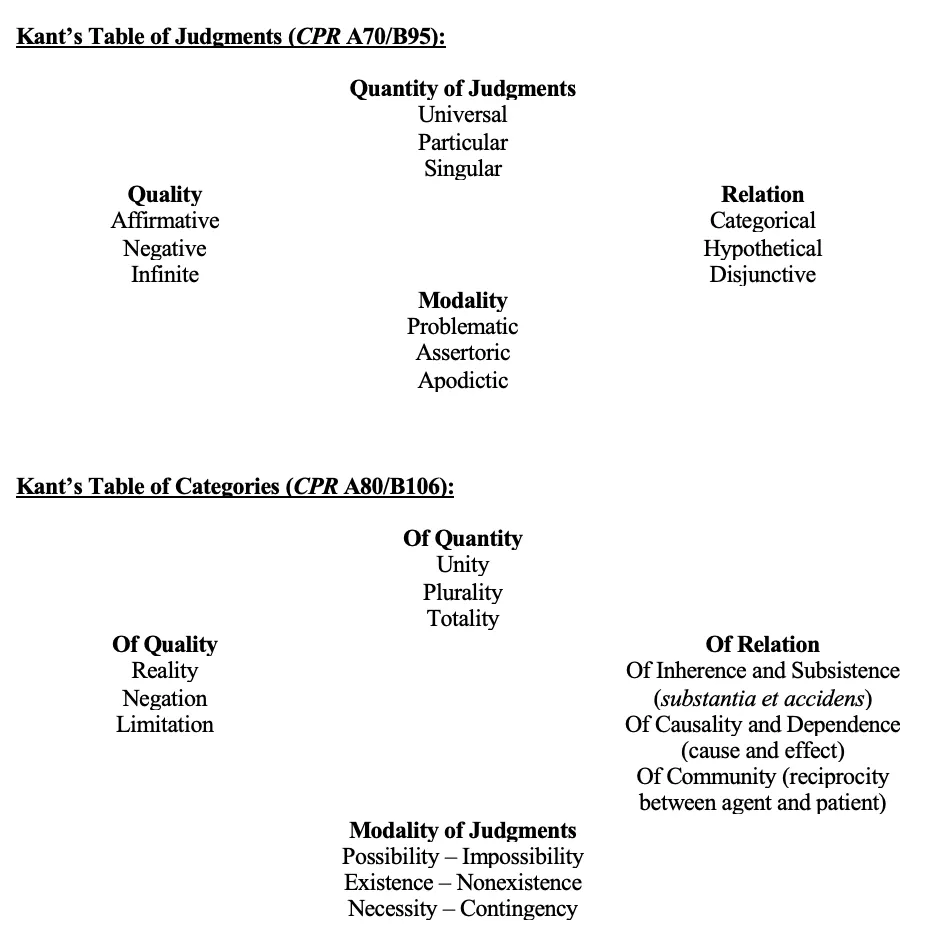
Obviously, a great deal can be said about these two tables, but the important part for Kant’s metaphysics is that the traditional metaphysical concepts like substance and cause are no longer transcendent to the cognitive process but immanent to it, such that the transcendent concepts of metaphysics are now transcendental concepts or internal conditions of the possibility of experience. Thus substance-accident relations are ways that the mind structures experience, not some outer relation of things in themselves. And causality is not a process “out there” but rather a form of conceptual experience structured at the most general level by the mind itself.
Thus, in Kant there is a return to a more robust notion of “innate ideas,” with the metaphysical concepts now part of the structuring activity of the mind (concepts being rules used in the judging of things), rather than things or entities in the world. Obviously, the empirical content of particular experiences will color and determine the particular substances, accidents, causes, effects, negations, and all the other pure concepts that are used to construct experience. Nonetheless, the basic building blocks of reality are present in the mind itself and are activated rather than discovered in the process of experience. Thus, in Kantian “transcendental idealism” the forms not only of intuition but also of conceptual understanding are ideal and produced by the mind, although the material elements of an experienced object are determined by interacting with things themselves. Thus, if in Raphael’s famous School of Athens painting Plato points to the Heavens for the place of the Forms, and Aristotle is pointing toward the level ground to find the Forms, Kant points to his head to show the transcendental location of the Forms.
Objective Validity of the Categories: The Transcendental Deduction
Given that the forms of understanding (the categories) are not discovered out there but activated in here, a natural (and skeptical) question arises: How does one know that the concepts of pure understanding actually apply to experience? How do we know that our concept of substance is a concept of substance? If concepts are our doings, how do we know that the world corresponds to them?
In answering this question, Kant develops a new type of philosophical argument called a “transcendental deduction” or “transcendental argument.”{18} Kant gives a number of versions in the Critique of Pure Reason, and the details are notoriously difficult. However, the basic idea is fairly straightforward. A transcendental deduction is a modalized form of modus ponens, and it looks like this:
<b>Transcendental Deduction</b>
P1: ◊p → q      (“The possibility of p entails q”)
<u>P2: p           (“p obtains”)</u>
C: q            (“q obtains”)
This is modus ponens with a possibility operator (◊). This makes all the difference since the possibility operator turns modus ponens from a “progressive” argument to a “regressive” argument.{19} Thus, in a transcendental argument, we are looking for the “conditions of the possibility of p,” and these conditions are q. Also importantly, the second premise has p and not ◊p; thus, the argument goes something like this:
P1: If p is possible, then q must obtain.
<u>P2: p obtains</u>
C: q must obtain
Kant assumes in the argument that p → ◊p, i.e., that the actuality of something entails its possibility. Kant uses transcendental arguments in all of his Critiques in order to secure his key concepts of each. Synthetic a priori concepts and judgments require a special kind of proof to secure their validity. The transcendental deduction is the proof for synthetic a priori concepts in theoretical, practical, aesthetic, and teleological judgments. In theoretical judgment, this works by securing the objective validity or validity of application of the categories to experience.
The basic point is that, for a unified experience to be possible (◊p), the categories must be objectively valid (q). Kant begins the transcendental deduction (in the B edition) thus:
The <b>I think</b> must <b>be able</b> to accompany all my representations; for otherwise something would be represented in me that could not be thought at all, which is as much to say that the representation would be either impossible or else at least would be nothing for me. (B131–132)This is p in the transcendental deduction: the unity of self-consciousness in representations, i.e., the fact that I am (or am able to be, ◊p) self-consciously aware of what I am thinking, hence that thought is not something that happens to me but something I do and am aware of.
But what makes p possible? What is q in the argument? In order to have a unified self-conscious experience, we need something that unifies the representations in the self-conscious experience. This unity is the work of the understanding:
<b>Understanding</b> is, generally speaking, the faculty of <b>cognitions</b>. These consist in the determinate relation of given representations to an object. An <b>object</b>, however, is that in the concept of which the manifold of a given intuition is <b>united</b>. Now, however, all unification of representations requires unity of consciousness in the synthesis of them. Consequently, the unity of consciousness is that which alone constitutes the relation of representations to an object, thus their objective validity, and consequently is that which makes them into cognitions and on which even the possibility of the understanding rests. (B137)Here we see that ◊p, the possibility of a unified conscious experience, depends on the unifying activity of understanding, which Kant calls “synthesis.” Using an image from Jay Rosenberg, we can think of this self-conscious synthesis as going from a “manifold of unities:”
(MU) I think A + I think B + I think C, . . .to a “unity of manifolds”:
(UM) I think [A + B + C + . . .].{20}But what are the means of this transition from MU to UM, the synthesis of representations that gives the unity of consciousness in a unity of experience? Here Kant returns to the logical functions of judgment, since these are the functions of the understanding which unify representations into a single conscious experience which I can think together through the categories. The conclusion is worth quoting in full:
The manifold that is given in a sensible intuition necessarily belongs under the original synthetic unity of apperception, since through this alone is the <b>unity</b> of the intuition possible. That action of the understanding, however, through which the manifold of given representations (whether they be intuitions or concepts) is brought under an apperception in general, is the logical function of judgments. Therefore all manifold, insofar as it is given in <b>one</b> empirical intuition, is <b>determined</b> in regard to one of the logical functions for judgment, by means of which, namely, it is brought to a consciousness in general. But now the <b>categories</b> are nothing other than these very functions for judging, insofar as the manifold of a given intuition is determined with regard to them. Thus the manifold in a given intuition also necessarily stands under the categories. (B143)
In UM, the categories are the “+” signs that bring together the various representations into the unified content of the judgment of experience. Thus, we have the transcendental deduction:
<b>Theoretical Deduction</b>
P1: ◊(Self-Conscious Experience) → Objective Validity of the Categories
<u>P2: Self-Conscious Experience</u>
C: Objective Validity of the Categories
As long as one admits self-conscious experience, what Kant calls the unity of apperception (being aware that you know something), one is entitled to assert the objective validity of the categories:
Consequently all synthesis, through which even perception itself becomes possible, stands under the categories, and since experience is cognition through connected perceptions, the categories are conditions of the possibility of experience, and are thus also valid a priori of all objects of experience. (B161)What Kant thinks he has proved is that experience of objects is not possible unless the categories structure that very experience because the objects of experience are themselves dependent upon the synthesizing activity of the categories. Thus, the only way to deny the objective validity of the categories is to deny the experience of objects. Hence, to ask how we are sure that the categories correspond to objects is to already have everything needed for the answer. You would not even know what an object is if you did not already have the categories working.
Kant’s Transcendental Deduction, like most things in philosophy, is controversial. I’ll only raise one famous and strong objection to such argumentation in general, ignoring whether Kant’s specific argument in the first Critique is valid.{21} According to Barry Stroud, if Kant is attempting to end skepticism regarding the mind-world (concept-object) relation with the transcendental deduction, he has failed and must necessarily fail. Evaluating Kant’s Transcendental Deduction, Stroud remarks:
What is remarkable is that Kant appears to reach [his] conclusions about the world and our knowledge of it from nothing more than the necessity with which all thinkers must think of and experience things in certain ways. This calls for closer attention because the fact that someone thinks or judges that such-and-such is so, even if his thinking it is required for his being able to think of anything at all, does not on its own seem to imply that what that thinker thereby thinks is true. Nor does it imply that what that thinker thereby thinks is something he knows to be true either. Everyone’s having to think it is one thing; its being true, or its being known to be true, is something else.{22}Kant’s Transcendental Deduction only proves that one must believe that the categories are objectively valid, not that the categories are objectively valid, which means a skeptic can still remain a skeptic about the objectivity of the categories even after granting the soundness of the Transcendental Deduction.{23}
The Transcendental Analytic continues after the Deduction with important material describing exactly how the synthesis of the categories works in various cases, especially the categories of relation and treats the transition from the pure concepts of understanding to the “schematized” concepts when space and time are added to the cognitive account. But for our purposes, the basic lines of Kant’s conception of cognitive metaphysics in the positive sense are done: General Metaphysics or Ontology is converted into Transcendental Logic as described by the Transcendental Aesthetic and Analytic of the first Critique.
Theoretical Prohibitions on Special Metaphysics: The Transcendental Dialectic
The second half of the CPR treats Special Metaphysics: the Soul, the World, and God. Kant calls this second division of the CPR the Transcendental Dialectic because he aims to show first that theoretical reason is caught in illusion and interminable dialectic regarding these special metaphysical matters, and second that his doctrine of transcendental idealism developed in the first half of the book offers a remedy (although not a solution) to the dialectics of special metaphysics.
Before giving his remedy, Kant offers a general diagnosis: theoretical reason, when seeking answers to special metaphysical questions regarding transcendent entities, finds itself caught in “transcendental illusion.” The work of the Transcendental Dialectic is to uncover and diagnose, but not remove, the illusion. This explains why special metaphysics is so perennial and yet liable to failure.
The transcendental dialectic will therefore content itself with uncovering the illusion in transcendental judgments, while at the same time protecting us from being deceived by it; but it can never bring it about that transcendental illusion (like logical illusion) should even disappear and cease to be an illusion. For what we have to do with here is a <b>natural</b> and unavoidable <b>illusion</b> which itself rests on subjective principles and passes them off as objective, whereas logical dialectic in its dissolution of fallacious inferences has to do only with an error in following principles or with an artificial illusion that imitates them. (CPR A297/B354)In the Dialectic, Kant distinguishes between three faculties: sensation, understanding, and reason, with reason being the “supreme faculty of cognition” (CPR A298/B355).
If the understanding may be a faculty of unity of appearances by means of rules [concepts], then reason is the faculty of the unity of the rules of understanding under principles. Thus it never applies directly to experience or to any object, but instead applies to the understanding, in order to give unity a priori through concepts to the understanding’s manifold cognitions, which may be called “the unity of reason,” and is of an altogether different kind than any unity that can be achieved by the understanding. (CPR A302/B359)Here reason is the faculty of principles, a second-order faculty of theoretical reason. Sensation and understanding are first-order faculties: they treat objects of experience. Reason, on the other hand, does not deal with objects of experience but with the cognitive faculties themselves. It thus treats the principles of experience qua principles, not experience. But the transcendental illusion comes into play when reason forgets its second-order status and instead treats the principles as objects of experience. This slip from second-order functioning to first-order functioning is what Kant sees as the error in special metaphysics: reason treats principles as objects, and thus we get the three classic topics of special metaphysics: the soul, the world, and God. As Kant puts it, reason slides from treating something as a logical maxim (a principle to seek the unconditioned in a conditioned series) to a real object (the sought after unconditioned as an object of experience), or what he calls the “transcendental ideas.”
Now all pure concepts have to do generally with the synthetic unity of representations, but concepts of pure reason (transcendental ideas) have to do with the unconditioned synthetic unity of all conditions in general. Consequently, all transcendental ideas will be brought under <b>three classes</b>, of which the <b>first</b> contains the absolute (unconditioned) <b>unity</b> of the <b>thinking subject</b>, the <b>second</b> the absolute <b>unity</b> of the <b>series</b> of <b>conditions of appearance</b>, the <b>third</b> the absolute <b>unity</b> of the <b>condition of all objects of thought</b> in general. (CPR A334/B391)Just as Kant had derived the categories from the functions of judgment in understanding, now the special objects of metaphysics, the soul, the world, and God are shown to be derived from reason’s overstepping its role: turning a logical maxim (“Seek the unconditioned!”) into an object of thought (“I found the Unconditioned entity!”). We can see this play out in the three topics of special metaphysics: the soul, the world, and God.
The Soul and Rational Psychology
Kant calls misguided thinking about the soul as a substance in rational psychology a “paralogism of pure reason” because the slide from logical maxim to real object in the rationalist metaphysician’s argument is a specific logical fallacy (and thus a para-logism). In the B edition of the Paralogisms section, Kant gives the following standard argument from rational psychology, by which he means the special metaphysics sections on the soul in German metaphysics.
P1: What cannot be thought otherwise than as subject does not exist otherwise than as subject and is therefore substance.
P2: Now a thinking being, considered merely as such, cannot be thought otherwise than as subject.
C: Therefore it [the thinking being] also exists only as such a thing, i.e., as substance.
Kant’s criticism is that the logical subject in P1 is quietly turned into a real subject in P2, but this is a fallacy figurae dictionis (the fallacy of equivocation). He says in an explanatory note:
‘Thinking’ is taken in an entirely different signification in the two premises: in the major premise [P1], as it applies to an object in general (hence as it may be given in intuition); but in the minor premise [P2] only as it subsists in relation to self-consciousness, where, therefore, no object is thought, but only the relation to oneself as subject (as the form of thinking) is represented. (CPR B411)
We can hear in this criticism a chiding of Descartes’ move from thought as thinking to “that I am a thinking thing,” which moves from a logical judgment to a real judgment. Thus, the Cartesian style of argument found in German metaphysics of Kant’s time is paralogistic, i.e., it does not show that one can move from the concept of a thinking to the reality of a thinking thing. Such an analysis is reminiscent of traditional arguments against the so-called “Ontological Proof” of God, where one moves from the concept of a Necessary Being to the existence of such a Being.
Nevertheless, even assuming the correctness of Kant’s analysis, it is important to note that Kant is not attacking the existence of a substantial soul in metaphysics, but merely the arguments for the existence of a substantial soul. Kant himself is committed to substantial souls, particularly of persons, in his philosophy; the point is a more local one against the arguments given for such souls.{24}
The World and Kantian Antinomies
After discussing the soul, Kant turns to the second object of special metaphysics: the world as a whole. This section is called the “Antinomy of Pure Reason” since Kant thinks that there are equally good arguments on both sides of the cosmological issues. Hence the title “Antinomy” for these arguments; in rational psychology the arguments are not good enough; in rational cosmology they are too good! Kant divides these antinomial arguments in two: (a) the “Mathematical” Antinomies and (b) the “Dynamical” Antinomies.
In the Mathematical Antinomies, Kant treats two questions: first, whether the world had a beginning or not (the First Antinomy), and second, whether the world is made of simple parts or not (the Second Antinomy). Kant thinks that in both cases the conclusions are false. It is not the case that the world is either finite or infinite in duration, and it is not the case that the world is either composed of simple parts or not so composed. The problem lies in assuming that there is some object called “the world” that these predicates could refer to. But Kant argues that seeing “the world” as an object is the product of transcendental illusion: treating the search for a unitary object (the world) as the predicating of a unitary object (the world). Since there is no such object for theoretical reason, there is no right answer to its properties in these Antinomies.
In the Dynamical Antinomies, Kant treats two additional questions: first, whether everything is determined or whether there are truly free actions (the Third Antinomy), and second, whether there is an absolutely necessary being or not (the Fourth Antinomy). In this case, both sides of the Antinomies are true according to theoretical reason. How is that possible? Here Kant appeals to his doctrine of transcendental idealism: the distinction between appearances and things in themselves. In the Third Antinomy, regarding appearances, everything is determined according to causal laws. Thus, Newtonian determinism reigns universally over all appearances. But, regarding things in themselves, free action is possible (and required, according to the arguments of practical philosophy), and there is no contradiction between determinism in appearances and freedom in things in themselves. Things are empirically determined but transcendentally free; or at least it is possible that there is transcendental freedom despite empirical determinism. In the Fourth Antinomy, regarding a necessary being, again the transcendental distinction does the work of showing no contradiction between affirming both sides of the issue but at different levels. As regards appearances, there is no absolutely necessary being and hence no stopping point in the search for reasons of things. But as regards things in themselves, there is nothing contradictory about an absolutely necessary being. Again, that an absolutely necessary being exists is not proved by this, rather the transcendental distinction creates the logical space for the possibility of such a being, whose existence is proved in practical philosophy.
Kant notes that the Antinomies provide an “indirect proof” of transcendental idealism since it is only by making the distinction between appearances and things in themselves (as made early in the Transcendental Aesthetic) that the Antinomies are resolvable:
Accordingly, the antinomy of pure reason in its cosmological ideas is removed by showing that it is merely dialectical and a conflict due to an illusion arising from the fact that one has applied the idea of absolute totality, which is valid only as a condition of things in themselves, to appearances that exist only in representation, and that, if they constitute a series, exist in the successive regress but otherwise do not exist at all. But one can, on the contrary, draw from this antinomy a true utility, not dogmatic but critical and doctrinal utility, namely that of thereby proving indirectly the transcendental ideality of appearances, if perhaps someone did not have enough in the direct proof in the Transcendental Aesthetic. (CPR A506/B534)Are the cosmological ideas of the soul, the world, and God of any use for theoretical reason? Yes, they are, but not as constitutive principles of reason “for extending the concept of the world of sense beyond all possible experience,” but rather as a “regulative principle of reason” that guides reason in searching out the conditions of experience with regard to the subject of thought, the series of thought, and the ground of unity of all thought. Reason, the faculty of the principles of understanding, demands objects of this unity, but these objects are merely logical objects for use in reason’s systematic search for deeper connections amongst all experiences. They are not real objects found in experience.
God and Rational Theology
The third section of the Dialectic treats the “Ideal of Pure Reason,” God Himself according to rational theology. Kant divides the proofs of traditional natural theology into three classes: (a) ontological proofs; (b) cosmological proofs; and (c) physico-theological proofs, or what might better be called “teleological proofs.” The third class Kant considers the most venerable: “This proof always deserves to be named with respect. It is the oldest, clearest and most appropriate to common human reason. It enlivens the study of nature, just as it gets its existence from this study and through it receives ever renewed force.” (CPR A623/B651)
Despite this veneration, such a proof for God is impossible since it “could at most establish a highest architect of the world, who would always be limited by the suitability of the material on which he works, but not a creator of the world, to whose idea everything is subject, which is far from sufficient for the great aim that one has in view, namely that of proving an all-sufficient original being” (CPR A627/B655). Thus, the third class of proof does not terminate in what one is looking for. What about the first two classes?
Kant’s analysis of the first class, which he called “ontological proofs,” is in some ways similar to traditional objections to it, namely the inability to go from the concept of a God to the existence of such a God. But Kant has a deeper analysis of the proof’s failure:
<b>Being</b> is obviously not a real predicate, i.e., a concept of something that could add to the concept of a thing. It is merely the positing of a thing or of certain determinations in themselves. In the logical use it is merely the copula of a judgment. The proposition <b>God is omnipotent</b> contains two concepts that have their objects: God and omnipotence; the little word “<b>is</b>” is not a predicate in it, but only that which posits the predicate <b>in relation</b> to the subject. (CPR A598/B626)Kant’s analysis here is seen (rightly in my view) to anticipate a distinction between operators in modern logic as developed by Gottlob Frege (1848–1925), where “is” is disambiguated into a universal quantifier (∀x) and an existential quantifier (∃x). Thus:
(1) ∀x (Gx → Ox), or “For all x, if x is God, then x is Omnipotent”As compared to:
(2) ∃x Gx, or “There exists an x such that x is God”Now in (1) one predicates concepts of an object, saying that God is Omnipotent such that the concept of God entails the concept of Omnipotence. But in (2) one affirms an object, that there is an object x that is God, or in short, that God exists. Kant’s critique is that the ontological argument slides from (1) to (2) without appreciating the distinction between the two senses of “is,” and thus treats existence as one of the predicates that could be entailed by the concept of God, which would look like this:
(3) ∀x (Gx → Ex), or “For all x, if x is God then x is Existent”But existence in the sense of reality is not a conceptual matter, but an existential matter, hence the need for (2) in making existence claims instead of (1). Thus, ontological proofs are logically problematic, which is a deeper criticism than the normal epistemological concerns that Kant also raises along with thinkers in the tradition such as St. Thomas.{25}
Having dispatched the ontological and the physico-theological arguments for God, Kant turns to the cosmological arguments, such arguments as St. Thomas makes in his First and Second Ways. Kant sees these classes of proof as unsound because they all depend on the ontological proof (already refuted). The Cosmological Proof “sets up an old argument [the ontological one] in disguised form as a new one [the cosmological one], and appeals to the agreement of two witnesses, namely a pure rational witness and another with empirical credentials, where only the first is there all alone, merely altering his clothing and voice so as to be taken for a second” (A606/B634).
What Kant is complaining of is that the cosmological proof slips in the concept of a necessary being, the product of the ontological proof, and pretends to find this being as the end of a chain of empirical inferences.
But it is clear that here [going from contingent being to a necessary being] one presupposes that the concept of a being of the highest reality completely suffices for the concept of an absolute necessity in existence, i.e., that from the former the latter may be inferred – a proposition the ontological proof asserted, which one thus assumes in the cosmological proof and takes as one’s ground, although one had wanted to avoid it. (CPR A607/B635)Thus, the dilemma for one arguing from the cosmological proofs: either it will end with a concept less than a necessary being and turn into the physico-theological style of proof; or it will bring us to a concept of an absolutely necessary being, but one whose existence can’t be proved from experience and therefore turns into the ontological proof proper. The cosmological proofs, then, turn out to be impossible as middle ways.
Besides the hidden assumption of the ontological argument, Kant also criticizes cosmological arguments for overstepping the conditions of experience, such as when applied to the category of causality beyond the world of appearances to things in themselves. Here again we find the transcendental illusion (going from the conditioned to the unconditioned), which we have no right to posit given that our concept of causality is only applicable to the realm of experience. Here, Kant is on shakier ground, given that he speaks of noumenal causality himself in regard to things in themselves affecting sensibility; but whether this violates his own strictures is controversial.{26}
Is the “Ideal of Pure Reason” to be done away with, then? No, for while we cannot appeal to God in theoretical reason as a constitutive idea, we can appeal to God as a regulative one, i.e., a means of bringing systematicity to our attempt to understand the world.
The ideal of the highest being is, according to these considerations, nothing other than a <b>regulative principle</b> of reason, to regard all combination in the world <b>as if it</b> arose from an all-sufficient necessary cause, so as to ground on that cause the rule of a unity that is systematic and necessary according to universal laws; but it is not an assertion of an existence that is necessary in itself. (CPR A619/B647)Depressing Conclusions of Special Metaphysics?
So the objects of special metaphysics—the soul, the world, and God—are not objects of theoretical reason but regulative ideas of reason itself in its relentless drive for unity and comprehension of experience. “In a word, this transcendental thing [a transcendental idea] is merely the schema of that regulative principle through which reason, as far as it can, extends systematic unity over all experience” (CPR A682/B710). Kant concludes his Transcendental Dialectic in this way:
Thus all human cognition begins with intuitions, goes from there to concepts, and ends with ideas. Although in regard to all three elements it has sources of cognition <em>a priori</em> which seem at first glance to scorn the boundaries of all experience, a completed critique convinces us that reason in its speculative use can with these elements never get beyond the field of possible experience, and that the proper vocation of this supreme faculty of cognition is to employ all its methods and principles only in order to penetrate into the deepest inwardness of nature in accordance with all possible principles of unity, of which the unity of ends is the most prominent, but is never to fly across the boundaries of nature, outside where this is <b>for us</b> nothing but empty space. (CPR A702/B730)It is a metaphysically depressing conclusion, it seems, and a good reason to think of Kant as “all-crushing” in regard to metaphysics. However, one must be careful, for it is speculative or theoretical reason that has its wings clipped from metaphysical flights of fancy. Here it is essential to remember Kant’s famous dictum from the B Preface: “Thus I had to deny knowledge in order to make room for faith;{27} and the dogmatism of metaphysics, i.e., the prejudice that without criticism reason can make progress in metaphysics, is the true source of all unbelief conflicting with morality, which unbelief is always very dogmatic” (CPR Bxxx). The term for “deny” is aufheben, which means not only “deny” or “cancel” but also “to replace at a higher level”—this is the term Hegel lights upon for his dialectical synthesis of previous moments in reason. Thus, his concern is not merely to negate knowledge but rather to put knowledge in the right place regarding the things of metaphysics. Second, Wissen is a technical and systematic term for scientia or science, as in Wissenschaft. Kant is not denying all knowledge, but rather a specific kind of knowledge, the scientific knowledge of the German rationalist system-builders of metaphysics. Finally, the point is to make room for Glauben (“faith” or “belief”), but for Kant this is not a revealed faith or belief, but the moral belief of the practical realm—freedom and moral responsibility. This would take front and center in the metaphysics of freedom as developed in the second Critique. “Pure reason has a presentiment of objects of great interest to it. It takes the path of mere speculation in order to come closer to these; but they flee before it. Presumably it may hope for better luck on the only path that still remains to it, namely that of its practical use” (CPR A796/B824).
Thus, the aim of the first Critique was to limit reason in its rationalist pretensions so as to make room for the metaphysics of morals, including freedom, the soul, and God. Kant, like the 1760s Pietist philosopher Crusius from whom he learned much, aimed to make philosophy safe for a metaphysics of freedom and morality; to do this he had to limit theoretical reason’s pretensions and create a space for practical reason in philosophy. The CPR completed the first half of the Pietist plan, but the second half was only gestured at. It is time to turn to Kant’s practical use of pure reason, especially as developed in the Groundwork for the Metaphysics of Morals (1785) and the Critique of Practical Reason (1788), and see what the Sage of Königsberg intended to put in the room made for rational faith.
IV. Kant’s Ethics: The Critique of Practical Reason and beyond
Introducing Crusian and Kantian Practical Philosophy
With the negative work finished, Kant, in the mid-1780s, quickly turned to writing his practical philosophy, or rather his treatment of pure reason in its practical use. This took shape in two works: the Groundwork for the Metaphysics of Morals (1785), a shorter text meant as an introduction to the fully developed Metaphysics of Morals published in 1797; and the second Critique, the Critique of Practical Reason (CPrR). Again, we will treat Kant’s revolution in practical philosophy by focusing on the key ideas and themes of these two works.
Although Kantian practical philosophy is revolutionary compared with much of what had gone before, it is again significantly dependent on Christian August Crusius’s practical philosophy. For our purposes, two Crusian themes are crucial: (1) Thelematology and (2) the distinction between obligations of virtue and prudence.
Because of the centrality of the will to Pietists in response to the Spinozism of the Leibnizian and Wolffian philosophy, Crusius develops a philosophical discipline from his teacher, Adolph Friedrich Hoffmann, called “Thelematology” or “Will-ology.” This is a theoretical prolegomena to practical philosophy and a metaphysical study of the nature and powers of the human will. Morally good objects or actions are determined by the goodness of the will’s activities, not the goodness of the object determining the moral goodness of the will. This focus on the will as the source of moral goodness goes hand in hand with the second key theme of Crusian practical philosophy: the distinction between obligations of virtue and obligations of prudence. Obligations of prudence are the obligations stemming from a metaphysical account of the perfection of the agent. Thus, one is obligated, by prudence, to eat correctly in order to bring about the perfection of one’s nature. But Crusius recognizes another kind of obligation, not stemming from the perfection of the agent, but from the command of God as Lord; these absolute obligations to fulfill what God wills, although they are often, or almost always, in conformity with what prudence dictates for our perfection, are not done because they will perfect our natures but because they are commanded by God’s law discovered in one’s conscience. Here we have what would later be called a distinction between the Right and the Good, or a development of the Anselmian and Scotistic distinction of the affectio commodi and the affectio iustitiae, the “affection for advantageousness” and the “affection for justice.” Both of these themes, Crusian Thelematology and the distinction in kinds of obligations, play central roles in Kant’s practical philosophy.
The Groundwork for the Metaphysics of Morals (1785)
Kant begins by declaring the twofold aim of the GMM: “The present groundwork is, however, nothing more than the search for and establishment of the supreme principle of morality, which constitutes by itself a business that in its purpose is complete and to be kept apart from every other moral investigation” (AA 4:392).
In the CPR Kant searched for and vindicated the supreme principles of theoretical cognition. In the GMM (and later in the CPrR) Kant aimed to do the same for the supreme principles of practical cognition or morality. The first two sections of the GMM aim to find the supreme principles of morality, and the third section aims to vindicate or establish them. And just as Kant deployed a “Copernican revolution” by looking not at the objects of thought but to the thinking of objects in the CPR, here too Kant looks not to the objects of the will, but to the willing of objects for the supreme principles of morality. This is Kant’s “Crusian Revolution” in practical philosophy, i.e., Kant’s own version of Thelematology, proclaimed immediately in the GMM’s opening line: “It is impossible to think of anything at all in the world, or even beyond it, that could be considered good without limitation except a good will” (AA 4:393).
Our Crusian prolegomena has prepared us for this move: looking to the will itself, not the objects of the will, as the source of moral goodness:
A good will is not good because of what it effects or accomplishes, because of its fitness to attain some proposed end, but only because of its volition, that is, it is good in itself and, regarded for itself, is to be valued incomparably higher than all that could merely be brought about by it in favor of some inclination and indeed, if you will, of the sum of all inclinations. (AA 4:394)This Crusian Revolution in Kant immediately drew criticism from more Aristotelian moral philosophers. H. A. Pistorius (1730–1798) demanded that Kant address first the good in general before treating the good will. In the CPrR Kant responded by explaining the “paradox of method”: “This is the place to explain the paradox of method in a Critique of Practical Reason, namely, that the concept of good and evil must not be determined before the moral law (for which, as it would seem, this concept would have to be made the basis) but only (as was done here) after it and by means of it” (AA 5:62–63).
Kant’s fundamental response is that if you don’t treat the will before the good, then you fail to understand the difference between theoretical and practical reason. This is because laws of the understanding are concerned with objects, while laws of morality are concerned with the will qua willing, not qua willed object:
For, the moral law is not concerned with cognition of the constitution of objects that may be given to reason from elsewhere but rather with a cognition insofar as it can itself become the ground of the existence of objects and insofar as reason, by this cognition, has causality in a rational being, that is, pure reason, which can be regarded as a faculty immediately determining the will. (AA 5:46)Theoretical reason, despite all the idealistic components of Kant’s doctrine, still relies on the causality of the things in themselves for its activity; practical reason relies only on itself and creates the objects (ends) through its own immediate causality: the power of freedom.
But let us return to the GMM and the supreme principle of morality, now identified as the moral law. What is the moral law? At the end of Section I, after reflecting on what constitutes a good will—acting not only in conformity with duty but out of respect for duty—and removing all sensuous inclinations and non-moral motives, Kant presents his results:
Since I have deprived the will of every impulse that could arise for it from obeying some law, nothing is left by the conformity of actions as such with universal law, which alone is to serve the will as its principle, that is, <em>I ought never to act except in such a way that I could also will that my maxim should become a universal law.</em> (AA 4:401)Kant clarifies what a maxim is compared with a moral law, in a corresponding footnote:
A <em>maxim</em> is the subjective principle of volition; the objective principle (i.e., that which would also serve subjectively as the practical principle for all rational beings if reason had complete control over the faculty of desire) is the practical <em>law</em>. (AA 4:401)Just as in theoretical reason, one brought singular intuitions under universal concepts; so, in practical reason, one brings singular maxims under the universal law, that is, the moral law. And just as the theoretical judgment had a special “every… must” form, so too practical judgment has its own modal form of judgment: “every… ought,” where the ought refers to some action. To be theoretically rational is to bring intuitions under the unity of the categories in judgment; to be practically rational is to bring one’s maxims under the unity of the moral law in judgment.
Having identified the supreme principle of morality, the moral law as a universal ought for all rational actions, Kant turns in Section II of the Groundwork to clarifying and unpacking the supreme principle. Here we find the second of the Crusian themes for practical philosophy, a distinction in obligations, or, as Kant calls them, imperatives:
The representation of an objective principle, insofar as it is necessitating for a will, is called a command (of reason), and the formula of the command is called an <b>imperative</b>. All imperatives are expressed by an ought and indicate by this the relation of an objective law of reason to a will that by its subjective constitution is not necessarily determined by it (a necessitation). . . . Now, all imperatives command either <em>hypothetically</em> or <em>categorically</em>. The former represent the practical necessity of a possible action as a means to achieving something else that one wills (or that it is at least possible for one to will). The categorical imperative would be that which represented an action as objectively necessary of itself, without reference to another end. (AA 4:413–414)Here we have Kant’s version of the Crusian distinction of obligations of prudence (Kant’s hypothetical imperatives) and absolute obligations of virtue (Kant’s categorical imperatives). The names Kant gives are based on the logical form of each imperative. For a hypothetical imperative, the ought is embedded in a hypothetical statement:
(HI) If I want X, then I ought φWhere φ is some action or omission. But a categorical imperative has the ought replacing the “is” of a categorical statement (“S is P”):
(CI) I ought φHere there is no condition on what one ought to do; and thus the obligation is absolute and universal; “objectively necessary of itself, without reference to another end,” as Kant says.
Having determined the logical form of the CI, Kant now unpacks a number of formulas for it.{28} Each formula gives another feature or aspect of the moral law as Kant describes it. The first formula is Kant’s primary formula, the one discovered in Section I and known as the “Formula of Universal Law” (FUL for short):
(<b>FUL</b>) Act only in accordance with that maxim through which you can at the same time will that it become a universal law. (AA 4:421)Kant adds another dimension to FUL while noting that the moral law should be willed as if it were a law of nature for us, as opposed to the law that sometimes conflicts with our natural inclinations (we having only imperfect and not, as God has, holy wills). This gives us the “Formula of the Law of Nature” or FLN for short:
(<b>FLN</b>) Act as if the maxim of your action were to become by your will a <b>universal law of nature</b>. (AA 4:421)The FUL and FLN focus on the act of willing, as one would expect, but what about the objects of willing? Obviously Kant can’t appeal to objects in the traditional sense of perfections or goods outside of the will. However, he can formulate the CI in terms of the objects of willing as the agents that will: rational wills. And this gives Kant his most famous formula of the CI, the “Formula of Humanity” or FH for short:
(<b>FH</b>) So act that you use humanity, whether in your own person or in the person of any other, always at the same time as an end, never merely as a means. (AA 4:429)Turning back to the act of willing, and now with the agent of willing in view, Kant produces another formula (what he calls the “third formula” since he seems to regard FUL and FLN as the same), the “Formula of Autonomy” or FA for short:
(<b>FA</b>) the idea of the will of every rational being as a will giving universal law. (AA 4:432) It is crucial to understand that Kant is not considering autonomy as an individual or subjectivist matter. Rather, autonomy is merely the unfolding of the universal moral law of practical reason seen from inside the agent, as it were. Thus, it is our reason that gives the moral law its force as an imperative, but we do not decide the content of the moral law. This distinction between force and content is essential to grasp lest Kant seem to be offering a relativistic and subjectivist moral system that is entirely up to us. Nothing could be further from his mind.
With the FA, Kant could now put multiple moral agents together as autonomous agents in a community, giving the final formula, the “Formula of the Kingdom of Ends” or FKE for short:
(<b>FKE</b>) Act in accordance with the maxims of a member giving universal laws for a merely possible kingdom of ends. (AA 4:439)The Kingdom of Ends is the idea of a universal commonwealth of rational agents (ends in themselves according to the FH). Here Kant points out the fundamental difference between things with dignity and things with price:
In the kingdom of ends everything has either a <em>price</em> or a <em>dignity</em>. What has a price can be replaced by something else as its <em>equivalent</em>; what on the other hand is raised above all price and therefore admits of no equivalent has a dignity. (AA 4:434)If we consider the FH and FA as describing rational wills, and the FUL and FLN as describing rational willing, then the FKE brings together nicely the other formulas in describing practical reason or morality: The Kingdom of Ends is nothing other than rational wills rationally willing.
With this Kant has identified the supreme principle of morality, the CI in its various formulas, and now turns to establishing or vindicating that principle in Section III. One would expect, given what had happened in the vindication of the categories in the CPR, to find here a Transcendental Deduction. In a way, we do, although he made a significant change to this deduction in the CPrR.{29}
Remember that a transcendental deduction looks like the following:
<b>Transcendental Deduction</b>
P1: ◊p → q      (“The possibility of p entails q”)
<u>P2: p           (“p obtains”)</u>
C: q            (“q obtains”)
So what are p and q in the Deduction of the Groundwork? Kant gives us a clue in the opening of Section III:
<em>Will</em> is a kind of causality of living beings insofar as they are rational, and <em>freedom</em> would be that property of such causality that it can be efficient independently of alien causes <em>determining</em> it, just as <em>natural necessity</em> is the property of the causality of all nonrational beings to be determined to activity by the influence of alien causes. (AA 4:446)The key terms for the Deduction are here: will, causality, and freedom, along with a hint of lawfulness. In the theoretical deduction, it was the possibility of unified experience that entailed the laws of the understanding (the categories). In the moral deduction, it is the possibility of freedom that entails the laws of morality, the moral law itself (CI).
Since the concept of causality brings with it that of laws in accordance with which, by something that we call a cause, something else, namely an effect, must be posited, so freedom, although it is not a property of the will in accordance with natural laws, is not for that reason lawless but must instead be a causality in accordance with immutable laws but of a special kind; for otherwise free will would be an absurdity. (AA 4:446)In this first step of the deduction, Kant identifies causality with laws and needs to explain what kind of laws are connected with the causality of freedom, since causality without laws is unintelligible, and freedom without causality is absurd:
Natural necessity was a heteronomy of efficient causes, since every effect was possible only in accordance with the law that something else determines the efficient cause to causality; what, then, can freedom of the will be other than autonomy, that is, the will’s property of being a law to itself. (AA 4:446–447)In this second step, Kant identifies the laws of freedom with autonomous laws and laws of natural necessity with heteronomous ones, thus setting up the final step of the deduction:
But the proposition, the will is in all its actions a law to itself, indicates only the principle, to act on no other maxim than that which can also have as object itself as a universal law. This, however, is precisely the formula of the categorical imperative and is the principle of morality; hence a free will and a will under moral laws are one and the same (AA 4:447).The argument is straightforward: freedom entails causality. Causality in freedom is autonomy. Autonomous causality is causality according to the moral law. Thus, the Moral Deduction looks like this:
<b>Moral Deduction I</b>
P1: ◊(freedom) → moral law   (“The possibility of freedom entails being under the moral law”)
<u>P2: freedom                  (“freedom obtains”)</u>
C: being under the moral law (“the moral law obtains”)
P1 is the transcendental inference, and P2 is the evidence for the antecedent (the fact of freedom). But how are we sure that we are free? Kant says this in defense:
I say now: every being that cannot act otherwise than <em>under the idea of freedom</em> is just because of that really free in a practical respect, that is, all laws that are inseparably bound up with freedom hold for him just as if his will had been validly pronounced free also in itself and in theoretical philosophy. (AA 4:448)But why is it that because I must act under the idea of freedom that I am free? Here we see again the Stroud objection to transcendental arguments: they seem to only prove that I must think myself in a certain way, but they do not prove that I am in a certain way, and in that way being actually free. This might be one of the reasons why Kant shifts the argument in the CPrR. However, before getting to that, Kant raises a potential problem for his deduction here: a vicious circle:
It must be freely admitted that a kind of circle comes to light here from which, as it seems, there is no way of escape. We take ourselves as free in the order of efficient causes in order to think ourselves under moral laws in the order of ends; and we afterwards think ourselves under moral laws because we have ascribed to ourselves freedom of will. (AA 4:450)What Kant is worried about is that freedom and being under the moral law are the same concept from two different angles, and thus one can’t use one to prove the other as a synthetic a priori principle, since synthetic principles need to add something to a concept, not merely unpack it through identities (like equivalent fractions in mathematics). To break this circle, Kant appeals to his doctrine of transcendental idealism: the distinction between appearances and things in themselves, here described as “two standpoints” one can take in understanding practical action:
A rational being must regard himself <em>as intelligence</em> (hence not from the side of his lower powers) as belonging not to the world of sense [world of appearances] but to the world of understanding [world of things in themselves]; hence he has two standpoints from which he can regard himself and cognize laws for the use of his powers and consequently for all his actions. (AA 4:452)Kant distinguishes between freedom as a power of persons as regards things in themselves—a causality that is not in space and time but in the noumenal realm and being under the moral law, which is something that the one feels with regard to appearances, as the inclinations push against one’s duty under moral law. Thus, the context of the causality involved in freedom in the antecedent of the transcendental inference and the being under the moral law in the consequent are not identical contexts, and thus there is no circle in the deduction.
For we now see that when we think of ourselves as free we transfer ourselves into the world of understanding as members of it and cognize autonomy of the will along with its consequence, morality; but if we think of ourselves as put under obligation we regard ourselves as belonging to the world of sense and yet at the same time to the world of understanding. (AA 4:453)This last paragraph clarifies that we are not two separate beings in two different worlds, but rather that our real self exists in the world of things in themselves but that the world of appearances and sensibility (inclinations, for instance) affects our real self in bringing about the feeling of obligation and duty that being under the moral law generates: the categorical imperative. But the causality of freedom does not involve the realm of appearances in its definition, whereas being under the moral law, the categorical imperative, does, since the ought” of the moral law is felt as a command conflicting with the inclinations of our sensible nature.
Apparently, Kant was not satisfied with the moral deduction in the GMM since he reversed the transcendental inference (P1) in the CPrR. He still saw the essential connection between acting under freedom and acting under the moral law. “The two concepts are so inseparably connected that one could even define practical freedom through independence of the will from anything other than the moral law alone” (AA 5:93–94). But Kant was no longer certain that he had insight into the noumenal aspects of freedom—the causality of freedom in the realm of things in themselves:
But no insight can be had into the possibility of the freedom of an efficient cause, especially in the sensible world: we are fortunate if only we can be sufficiently assured that there is no proof of its impossibility, and are now forced to assume it and are thereby justified in doing so by the moral law, which postulates it. (AA 5:94)Kant never goes back on the results of the Third Antinomy of the first Critique. There is a logical space for free will at the level of things themselves, but in the CPrR he was no longer as sure one can have direct insight into freedom as he was in the GMM. Thus, Kant reverses the transcendental inference in the Moral Deduction of the CPrR in what is called the “Fact of Reason” argument:
Consciousness of this fundamental law [the moral law] may be called a fact of reason [<em>ein Faktum der Vernunft</em>] because one cannot reason it out from antecedent data of reason, for example, from consciousness of freedom (since this is not antecedently given to us) and because it instead forces itself upon us of itself as a synthetic a priori proposition that is not based on any intuition, either pure or empirical, although it would be analytic if the freedom of the will were presupposed; but for this, as a positive concept, an intellectual intuition would be required, which certainly cannot be assumed here. (AA 5:31)Kant’s new deduction looks like the following:
<b>Moral Deduction II</b>
P1: ◊(being under the moral law) → freedom (“The possibility of being under the moral law entails freedom”)
<u>P2: being under the moral law               (“the moral law obtains”)</u>
C:freedom                     (“freedom obtains”)
P1 is the new transcendental inference, a principle known as “ought implies can.”{30} Simply said, the possibility of moral responsibility depends upon the freedom to do otherwise.{31} P2 is the “Fact of Reason,” the experience of being under the moral law that Kant assumes everyone can recognize. Thus, the conclusion follows that we are free in our actions. But what kind of freedom is this? Kant often calls it “practical freedom,” which might sound like a matter of considering oneself free or taking oneself to be free from a practical point of view. But Kant does not mean merely this kind of freedom in consideration. He means authentic, metaphysically robust, transcendental freedom—the free causality of noumenal selves in the realm of things in themselves.
For, there are many who believe that they can nevertheless explain this freedom in accordance with empirical principles, like any other natural ability, and regard it as a psychological property, the explanation of which simply requires a more exact investigation of the <em>nature of the soul</em> and of the incentives of the will, and not as a <em>transcendental</em> predicate of the causality of a being that belongs to the sensible world (although this is all that is really at issue here); and they thus deprive us of the grand disclosure brought to us through practical reason by means of the moral law, the disclosure, namely of an intelligible world through realization of the otherwise transcendent concept of freedom, and with this deprive us of the moral law itself, which admits absolutely no empirical determining ground. (AA 5:94) Kant calls attempts to reconcile determinism with freedom (today called a Compatibilist Account of Freedom) a “wretched subterfuge”: “If the freedom of our will were none other than [this] (say, psychological and comparative but not also transcendental, i.e., absolute), then it would at bottom be nothing better than the freedom of a turnspit, which, when once it is wound up, also accomplishes its movements of itself” (AA 5:96–97).
Furthermore, since Kant thinks that his doctrine of transcendental idealism, the distinction between things in themselves and appearances, is the only way to block determinism, he sees himself as offering a serious aid in the Pietist crusade against Spinozism:
Hence, if [the] ideality of time and space is not adopted, nothing remains but Spinozism, in which space and time are essential determinations of the original being itself, while the things dependent upon it (ourselves, therefore, included) are not substances but merely accidents inhering in it; for, if these things exist merely as its effects <em>in time</em>, which would be the condition of their existence itself, then the actions of these beings would have to be merely its actions that it performs in any place and at any time. (AA 5:101–102)The summum bonum and virtue
Kant’s “paradoxical method” of looking first to the will before sorting out what the good is can look like the traditional notion of the summum bonum or the “highest good” of moral philosophy has gone missing. But this lack is only apparent. In fact, Kant is very clear that the end of practical reason is not duty for duty’s sake, but the highest good, the union of virtue and happiness according to proper proportion.
Now, inasmuch as virtue and happiness together constitute possession of the highest good in a person, and happiness distributed in exact proportion to morality (as the worth of a person and his worthiness to be happy) constitutes the <em>highest good</em> of a possible world. (AA 5:110–111)We have already seen that the final formula of the CI is the Kingdom of Ends: rational wills rationally willing, which is a description of a common or highest good of all things. But in the Dialectic of the CPrR, Kant, perhaps because of criticisms of his ethics on this point, makes the importance of the highest good explicit. The Antinomy of Practical Reason involves the concepts of virtue (here understood as duty) and happiness. How are these two things related? According to Kant, the Epicureans and Stoics both saw the relation as one of identity, with the Epicureans reducing virtue to happiness and the Stoics reducing happiness to virtue. But virtue is not happiness; rather, virtue, or acting under the moral law, is the condition or cause of happiness. But if happiness is the end of moral action, then how is virtue or duty the determining ground and sole aim of moral action? How are duty and happiness related without one collapsing into the other?
As we might expect, Kant uses his transcendental idealism to solve the antinomy, just as he had done with the Third Antinomy regarding freedom and determinism in the CPR. Simply said: if morality was a matter of the appearances alone, then there would be no solution; but if one sees that there is a realm of things in themselves as well as a realm of appearances, then virtue and happiness can coincide based on connections with things in themselves, although not necessarily within the world of appearances.
But since I am not only warranted in thinking of my existence also as a noumenon in a world of the understanding but even have in the moral law a purely intellectual determining ground of my causality (in the sensible world), it is not impossible that morality should have a connection, and indeed a necessary connection, as cause with happiness as effect in the sensible world, if not immediately yet mediately (by means of an intelligible author of nature), a connection which, in a nature that is merely an object of the senses, can never occur except contingently and cannot suffice for the highest good. (AA 5:114–115)In the sensible world, there is no assurance that virtue will lead to happiness. But if we are also beings in the intelligible world, virtue can lead to happiness under certain conditions. These conditions are immortality of the soul and the existence of a personal God.
Return of special metaphysics
With the Fact of Reason and our feeling of the moral law through respect, we have gained a beachhead on the world of things in themselves; what was deprived of us in speculative thought is provided, nay demanded, in practical thought. We must think about and affirm the existence of the immortal soul and a personal God. Why? In each case Kant offers something of a transcendental deduction based upon the conditional connection established above between virtue and happiness in the highest good. We need virtue and happiness to be connected (with happiness as the reward for virtue), otherwise the highest good is an empty, fanciful concept. But thinking of virtue and happiness alone can’t bring about this connection (this was the Antinomy of Practical Reason). Since we gained access to the noumenal realm through our cognizing of freedom according to the Fact of Reason, we are now in a position to affirm the traditional denizens of special metaphysics: the immortal soul and God. Kant calls both of these “Postulates of Practical Reason,” a term he also uses for freedom since all are derived from the Fact of Reason in the experience of the moral law.
Return of the Soul: Immortality
Kant argues for immortality of the soul based on the consideration of perpetual moral progress.
The production of the highest good in the world is the necessary object of a will determined by the moral law. But in such a will the <em>complete conformity</em> of dispositions with the moral law is the supreme condition of the highest good. This conformity must therefore be just as possible as its object is, since it is contained in the same command to promote the object. Complete conformity of the will with the moral law is, however, <em>holiness</em>, a perfection of which no rational being of the sensible world is capable at any moment of his existence. Since it is nevertheless required as practically necessary, it can only be found in an <em>endless progress</em> toward that complete conformity, and in accordance with principles of practical reason it is necessary to assume such a practical progress as the real object of our will. This endless progress is, however, possible only on the presupposition of the <em>existence</em> and personality of the same rational being continuing <em>endlessly</em> (which is called the immortality of the soul). (AA 5:112)The highest good requires perpetual progress, and thus the possibility of the highest good entails the immortality of the soul.
<b>Immortality Deduction</b>
P1: ◊(highest good) → immortality of the soul (“The possibility of being under the moral law entails immortality of the soul”)
<u>P2: highest good                                                (“the highest good obtains”)</u>
C: immortality of the soul                                 (“immortality of the soul obtains”)
Now this is not technically a transcendental deduction because P2 is not a direct experience (as was the case in the Theoretical and Moral Deductions), but rather a necessary inference based upon the Fact of Reason, which is the direct experience needed for a transcendental deduction. Thus, P2 and therefore C are postulates. Nevertheless, these postulates are necessary if the Moral Deduction is sound, which Kant thinks it is, and thus they are asserted with as much certainty as the truths of speculative thought. Kant writes of the practical postulates in general that “those concepts [immortality, freedom, and God] otherwise problematic (merely thinkable) for it, are now declared assertorically to be concepts to which real objects belong, because practical reason unavoidably requires the existence of them for the possibility of its object, the highest good, which is absolutely necessary practically, and theoretical reason is thereby justified in assuming them” (AA 5:134).
Thus, we find the same language of justification that Kant uses in the first Critique for describing the categories as objectively valid; the difference being that the concepts of the soul and God are for practical reason’s use, not for theoretical reason’s pure speculation.
In this they [the soul, freedom, and God] become <em>immanent</em> and <em>constitutive</em> inasmuch as they are grounds of the possibility of <em>making real the necessary object</em> of pure practical reason (the highest good), whereas apart from this they are <em>transcendent</em> and merely <em>regulative</em> principles of speculative reason, which do not require it to assume a new object beyond experience but only to bring its use in experience nearer to completeness. (AA 5:135)Return of God: Existence and Divine Attributes
Thus, the postulate of immortality secures the possibility of virtue and happiness being connected in the highest good, but what secures the actuality of this connection? Here we find God as necessarily affirmed, and not just any God but the God of Christian theology, with traditional divine attributes:
In the preceding analysis the moral law led to a practical task that is set by pure reason alone and without the aid of sensible incentives, namely that of the necessary completeness of the first and principal part of the highest good, <b>morality</b>; and, since this can be fully accomplished only in an eternity, it led to the postulate of <em>immortality</em>. The same law must also lead to the possibility of the second element of the highest good, namely <b>happiness</b> proportioned to that of morality, and must do so as disinterestedly as before, solely from impartial reason; in other words, it must lead to the supposition of the existence of a cause adequate to this effect, that is, it must postulate the <em>existence of God</em> as belonging necessarily to the possibility of the highest good (which object of our will is necessarily connected with the moral lawgiving of pure reason). (AA 5:124)Here again we have the deduction form, again derivative of the Moral Deduction for the experience of P2.
<b>Divine Deduction</b>
P1: ◊(highest good) → God exists (“The possibility of the highest good entails the existence of God”)
<u>P2: highest good                             (“the highest good obtains”)</u>
C: the existence of God                 (“the existence of God obtains”)
This is why, for Kant, morality leads to religion as a necessary component:
For this reason, again, morals is not properly the doctrine of how we are to <em>make</em> ourselves happy but of how we are to become <em>worthy</em> of happiness. Only if religion is added to it does there also enter the hope of some day participating in happiness to the degree that we have been intent upon not being unworthy of it. (AA 5:130)So for the highest good to become actual, there must be a God who can apportion happiness to virtue and punishment to vice and wickedness; if there was no such God then morality would be empty and fanciful, a chimera of our minds. But notice that it is not merely God’s existence that is found through practical reason but also a number of things about this God, specifically the traditional divine attributes. For God to fill the role Kant sees him as filling, he must be a God who is perfect, omniscient, omnipotent, and omnibenevolent:
I find that the moral principle admits [the concept of the highest good] as possible only on the presupposition of an author of the world possessed of the <em>highest perfection</em>. He must be <em>omniscient</em> in order to cognize my conduct even to my inmost disposition in all possible cases and throughout the future, <em>omnipotent</em> in order to bestow results appropriate to it, and so too <em>omnipresent</em>, <em>eternal</em>, and so forth. Thus the moral law, by means of the concept of the highest good as the object of a pure practical reason, determines the concept of the original being as the <em>supreme being</em>, something that the physical (and, pursued higher, the metaphysical) and so the whole speculative course of reason could not effect. The concept of God, then, is one belonging originally not to physics, that is, to speculative reason, but to morals, and the same can be said of the other concepts of reason which we treated above as postulates of reason in its practical use. (AA 5:140)Concluding the Critical Project . . .
Kant concludes the CPrR with a beautiful and justly famous passage:
Two things fill the mind with ever new and increasing admiration and reverence, the more often and more steadily one reflects on them: <em>the starry heavens above me and the moral law within me</em>. . . . The first view of a countless multitude of worlds annihilates, as it were, my importance as an animal creature, which after it has been for a short time provided with vital force (one knows not how) must give back to the planet (a mere speck in the universe) the matter from which it came. The second, on the contrary, infinitely raises my worth as an <em>intelligence</em> by my personality, in which the moral law reveals to me a life independent of animality and even of the whole sensible world, at least so far as this may be inferred from the purposive determination of my existence by this law, a determination not restricted to the conditions and boundaries of this life but reaching into the infinite. (AA 5:161–162)With these words, it seems that Kant, in 1788, had concluded his metaphysical map of reason, charting its theoretical and practical uses and powers and giving an exhaustive account of the two irreducible aspects of reason: theoretical and practical. The Kantian project is a fundamentally dualist project in the wake of Descartes and other early modern philosophers; but no one had given such a comprehensive account of the depth of a dualist metaphysics of nature and morals until the completion of the project in 1788. But, as it turned out, Kant was not finished, and in 1790 another Critique was published: the Critique of the Power of Judgment (CPJ).
V. Kant’s Aesthetics and Teleology: The Critique of the Power of Judgment and beyond
Why a third Critique?
Why a third Critique? What more is there beyond the starry heavens and the moral law, beyond particles and persons? In a sense, nothing is beyond these two realms, since God is treated in the CPrR according to the moral law; instead, the question is what is between these two realms. How are these two realms related? Is there a unity in reason, or are we left with, in the end, two irreducible realms and two irreducible acts of reason: reasoning about nature and reasoning about morality? The third Critique aims to secure a kind of unity between the two concepts of nature and morality, as Kant writes in the introduction to the third Critique:
Now although there is an incalculable gulf fixed between the domains of the concept of nature, as the sensible, and the domain of the concept of freedom, as the supersensible, so that from the former to the latter (thus by means of the theoretical use of reason) no transition is possible, just as if there were so many different worlds, the first which can have no influence on the second: yet the latter <b>should</b> [<em>soll</em>] have an influence on the former, namely the concept of freedom should make an end that is imposed by its laws real in the sensible world. (AA 5:176)The emphasized verb is crucial: should or Sollen in German. Of course, this is the same German word translated in the CPrR as ought, but here and throughout the CPJ should is the appropriate translation because this modal verb is distinctive of the kind of necessity that Kant is investigating in the CPJ. We saw that transcendental philosophy treats a special kind of modal judgment; the CPR treats every–must judgments and the CPrR treats every–ought judgments. But in the CPJ Kant treats “should” judgments, or judgments of the form every–should. Corresponding to “should” judgments is a new concept: purposiveness. It is this concept, (purposiveness), that serves to unify nature and freedom:
Now since the concept of an object insofar as it at the same time contains the ground of the reality of this object is called an <b>end</b>, and the correspondence of a thing with that constitution of things that is possible only in accordance with ends is called the <b>purposiveness</b> of its form [<em>die Zweckmäßigkeit der Form</em>], thus the principle of the power of judgment in regard to the form of things in nature under empirical laws in general is the <b>purposiveness of nature</b> in its multiplicity. (AA 5:180)The unity between the concepts of nature and freedom is found in the concept of purposiveness, a transcendental concept from the power of judgment, a power which it turns out has two forms itself: determining judgment and reflecting judgment. The CPR, Kant now says, treated determining judgment, the application of concepts to objects, or universals to particulars; but the power of judgment itself has a prior and grounding activity, that of reflecting judgment, which Kant describes as reflecting on a particular to find a universal. Thus, prior to a determining judgment, the particulars must be given some unity in a universal, and this is the task of the power of judgment proper. Thus the need for three Critiques, each treating a fundamental faculty of thinking: the CPR treating the faculty of understanding, the CPrR treating the faculty of reason and the CPJ treating the ground of both faculties: the faculty of judgment.
Divisions in the Power of Judgment
Going back to our gulf between particles and persons, or the concepts of nature and freedom, it might not surprise us to find the CPJ divided into two sections: the first treating Aesthetic Judgment and the second treating Teleological Judgment. Here again a unity question appears: What hath art and the beautiful to do with nature and the purposeful? The answer again is in the power of judgment as a reflecting power, with purposiveness as the basic concept in both areas. Aesthetics, or the treatment of the beautiful, is a matter of internal purposiveness—the purposiveness of the internal workings of the mind when treating objects. Teleology, or the treatment of natural purposes, is a matter of external purposiveness—the purposiveness of the things found in nature and animals in particular but also the entire system of nature according to purpose.
The focus on the “purposiveness of form” in the internal and external aspects of reality brings back a concept that seemed banished from post-Cartesian philosophy: final causality. In the CPJ, it makes a Kantian return, opening up avenues for natural philosophy which had seemed closed off by Descartes and modern mechanistic philosophy. The return of final causality also means the return of the physico-teleological proofs of God, now appearing as the culminating reflections on a world according to purposiveness.
The Critique of the Aesthetic Power of Judgment
The aspect of purposiveness of form in the aesthetic section of the Critique treats the purposiveness of the cognitive faculties prior to a determining judgment in either the theoretical or practical use of reason.
Now the purposiveness of a thing, insofar as it is represented in perception, is also not a property of the object itself (for such a thing cannot be perceived), although it can be derived from a cognition of things. Thus the purposiveness that precedes the cognition of an object, which is immediately connected with it even without wanting to use the representation of it for a cognition, is the subjective aspect of it that cannot become an element of cognition at all. The object is therefore called purposive in this case only because its representation is immediately connected with the feeling of pleasure; and this representation itself is an aesthetic representation of the purposiveness. (AA 5:189)Aesthetic purposiveness is the internal aspect of purposiveness that comes as the mind moves from sensing an object to imagining and understanding it. In fact, aesthetic judgment is the judgment made about the representing of the object on the way to a determining judgment, if a determining judgment is to be had. As noted above, reflective judgments move from the particular to the universal, and aesthetic judgments are about this process, the feeling of pleasure that one has in moving from the particulars to a universal concept that can then be applied in judgments of the understanding. The concept applied in aesthetic judgments is beauty, and thus Kant provides an Analysis of the Beautiful according to his fourfold division of Quantity, Quality, Relation, and Modality.
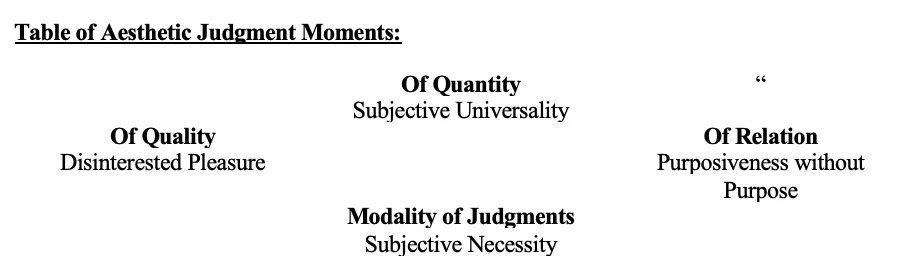
Kant sees these four moments as essential to the aesthetic judgment, which takes the form “X is beautiful.” Let’s take each moment in turn.
The quantity of an aesthetic judgment is subjective universality. The universality of the judgment gives us the every of the every–should judgment form. Thus, when someone says that “X is beautiful,” he or she is not making a mere personal judgment, but a universal one: it goes for everyone. Nonetheless, it is not an objective judgment since the target of the judgment is not the object itself (as in a determining judgment), but the judgment itself, which is in the subject. But since the subjects making the judgment are all humans, it is a universal (although subjective) judgment. More specifically, the aesthetic judgment is subjective because it is about a certain state of mind:
The powers of cognition that are set into play by this representation are hereby in a free play, since no determinate concept restricts them to a particular rule of cognition. Thus the state of mind in this representation must be that of a feeling of the free play of the powers of representation in a given representation for a cognition in general. Now there belongs to a representation by which an object is given, in order for there to be cognition of it in general, <b>imagination</b> for the composition of the manifold of intuition and <b>understanding</b> for the unity of the concept that unifies the representations. (AA 5:217)Thus, the aesthetic judgment is about the activity of cognition, not a cognized object, and thus it is prior to and grounds any cognition of an object. And since it is based on the “free play” or interaction of imagination and understanding, two faculties of the mind possessed by all humans, it is a universal judgment. Kant ends the section with a definition: “That is beautiful which pleases universally without a concept” (AA 5:219).
The second moment, quality, refers to the aesthetic judgment being based in disinterested pleasure. The combination of disinterest and pleasure may seem strange, but Kant is referring to disinterested in a sense of lacking an interest in something as a means to an end. For Kant the aesthetic judgment (“X is beautiful”) means that, judgment-wise, beauty is an end in itself. Something is not beautiful for another end; something is simply beautiful. This places beauty between the merely pleasurable (the agreeable) and the moral (the good):
<b>Agreeable</b> is that which everyone calls what <b>gratifies</b> him; <b>beautiful</b>, what merely <b>pleases</b> him; <b>good</b>, what is <b>esteemed</b>, <b>approved</b>, i.e., that on which he sets an objective value. Agreeableness is also valid for nonrational animals; beauty is valid only for human beings, i.e., animal but also rational beings, but not merely as the latter (e.g., spirits), rather as beings who are at the same time animal; the good, however, is valid for every rational being in general. (AA 5:210)According to Kant, humans alone can make aesthetic judgments, being in both the sensible and supersensible world. Mere animals have senses and thus find things agreeable or pleasurable in a merely subjective sense. Pure spirits lack senses and thus find things good by judging morally based on the universal of the moral law. But humans are both sensible and rational, and aesthetic judgments involve both the particular (the feeling of pleasure) but also the universal (a disinterested feeling of pleasure). Kant gives a definition of the beautiful from this moment: “Taste is the faculty for judging an object or a kind of representation through a satisfaction or dissatisfaction without any interest. The object of such a satisfaction is called beautiful” (AA 5:211).
The third moment, relation, is perhaps the most difficult to understand: purposiveness without a purpose. In a way we are prepared for this, since the quality of an aesthetic judgment is disinterested pleasure, a paradoxical combination of properties. Disinterestedness relates to the purposelessness aspect—there is no further purpose for these aesthetic judgments, they are ends in themselves for the process of cognition. And just as there was a feeling of pleasure involved, so too there is a purposiveness, i.e. a feeling of purpose, involved in such judgments. Kant speaks of this as a kind of causality:
If one would define what an end is in accordance with its transcendental determinations (without presupposing anything empirical, such as the feeling of pleasure), then an end is the object of a concept insofar as the latter [the concept] is regarded as the cause of the former (the real ground of its possibility); and the causality of a <b>concept</b> with regard to its <b>object</b> is purposiveness (<em>forma finalis</em>). (AA 5:219–20)Purposiveness is the causality of a concept, the causality of how a concept as applied to intuitions brings about an object in the cognitional process. Aesthetic judgment is about this causality, the way of bringing objects about, not about any particular caused object. The aesthetic judgment “does not concern any concept of the constitution and internal or external possibility of the object through this or that cause, but concerns only the relation of the powers of representation to each other insofar as they are determined by a representation” (AA 5:221). Thus Kant’s third definition of the beautiful: “Beauty is the form of the purposiveness of an object, insofar as it is perceived in it without representation of an end” (AA 5:236).
Modality, the fourth moment, deals with the should aspect of the every-should form of aesthetic judgments: subjective necessity. Thus, like quantity, which deals with the “every” part of the every-should form, there are two aspects of this moment: (1) subjectivity and (2) necessity.
The judgment of taste ascribes assent to everyone, and whoever declares something to be beautiful wishes that everyone <b>should</b> approve [<em>erklären solle</em>] of an object in question and similarly declare it to be beautiful. The <b>should</b> [<em>Das Sollen</em>] in aesthetic judgments of taste is thus pronounced only conditionally even given all the data that are required for the judging. One solicits assent from everyone else because one has a ground for it that is common to all; one could even count on this assent if only one were always sure that the case were correctly subsumed under that ground as the rule of approval. (AA 5:237)The aesthetic judgment has the force of necessity because the judgment is based in the workings of the faculties of cognition—imagination and understanding—and therefore is based in a universal structure of the mind not open to personal or contingent demands. Nevertheless, it is not an objective necessity because the judgment is not about an object qua object, but an object qua source of representations, and thus it is in internal matter. The object is called beautiful in the aesthetic judgment, but this is not the determining judgment of constituting an object through a concept; rather, it is a reflecting judgment on the process of cognition of the object. Thus, while one expects and even demands universal assent regarding aesthetic judgments, this necessity is not a must-necessity, but a should-necessity. One should agree, but one might not. “That is beautiful which is cognized without a concept as the object of a necessary satisfaction” (AA 5:240).
The Deduction of Taste or Aesthetic Judgment
Since aesthetic judgments, like theoretical and practical judgments, are synthetic, a priori judgments, the principles—here the principle of beauty analyzed into the four moments—require a transcendental deduction. Kant provides the deduction in §38:
If it is admitted that in a pure judgment of taste the satisfaction in the object is combined with the mere judging of its form, then it is nothing other than the subjective purposiveness of that form for the power of judgment that we sense as combined with the representation of the object in the mind. Now since the power of judgment in regard to the formal rules of judging, without any matter (neither sensation nor concept), can be directed only to the subjective conditions of the use of the power of judgment in general (which is restricted neither to the particular kind of sense nor to a particular concept of understanding), and thus to that subjective element that one can presuppose in all human beings (as requisite for possible cognitions in general), the correspondence of a representation with these conditions of the power of judgment must be able to be assumed to be valid for everyone a priori. I.e., the pleasure or subjective purposiveness of the representation for the relation of the cognitive faculties in the judging of a sensible object in general can rightly be expected of everyone. (AA 5:289–90)Before formalizing this, what Kant is pointing out is that aesthetic judgment is based on the powers of cognition, specifically the faculties of imagination and understanding. And if one regarded the free play of these powers as a principle, Kant calls it a principle of a “communal sense.” He does not mean the theoretical “common sense” but a “communal sense,” as in the feeling of disinterested pleasure of the imagination and understanding working together.
By “<em>sensus <b>communis</b></em>,” however, must be understood the idea of a <b>communal</b> sense, i.e., a faculty for judging that in its reflection takes account (a priori) of everyone else’s way of representing in thought, in order <b>as it were</b> to hold its judgment up to human reason as a whole and thereby avoid the illusion which, from subjective private conditions that could easily be held to be objective, would have a detrimental influence on the judgment. (AA 5:293)Common or communal sense serves as the ground for the universality and necessity of the aesthetic judgment:
Thus only under the presupposition that there is a common sense [<em>Gemeinsinn</em>] (by which, however, we do not mean any external senses but rather the effect of the free play of our cognitive powers), only under the presupposition of such a common sense [<em>Gemeinsinns</em>], I say, can the judgment of taste be made. (AA 5:238)The common sense or faculty for judging is the target of the deduction—if this power as analyzed in the four moments, can be assumed for everyone, then aesthetic judgments can be proved valid for everyone. Now we can formalize Kant’s Aesthetic Deduction. Remember the form of a transcendental deduction:
<b>Transcendental Deduction</b>
P1: ◊p → q      (“The possibility of p entails q”)
<u>P2: p           (“p obtains”)</u>
C: q            (“q obtains”)
How do we go from Kant’s paragraph in §38 to this? Easily:
<b>Aesthetic Deduction</b>
P1: ◊(communication) → common sense (“The possibility of communication entails a common sense”)
<u>P2: communication                   (“communication obtains”)</u>
C: common sense                     (“a common sense obtains”)
What Kant argues is that if communication is possible between humans as rational beings, then they must possess the same cognitive powers (or common sense).
Cognitions and judgments must, together with the conviction that accompanies them, be able to be universally communicated, for otherwise they would have no correspondence with the object: they would all be a merely subjective play of the powers of representation, just as skepticism insists. But if cognitions are to be able to be communicated, then the mental state, i.e., the disposition of the cognitive powers for a cognition in general [i.e. the common sense], and indeed that proportion which is suitable for making cognition of a representation (whereby an object is given to us) must also be capable of being universally communicated; for without this, as the subjective condition of cognizing, the cognition, as an effect, could not arise. (AA 5:238–39)This can be restated in a simple way. If one is able to communicate with another, then this must be because one has the same cognitive powers and can be in the same mental state/disposition. Thus, aesthetic judgments are valid for all people; they are every-should judgments as Kant sought to prove.
Judgments of the Sublime
Before moving to the Critique of Teleological Judgment, we ought to mention Kant’s conception of the sublime. If judgments of beauty involve the imagination and the understanding in free play, and hence deal with the material in the CPR, then it is judgments of the sublime that involve the imagination and reason and hence deal with material from the CPrR. Kant makes this connection explicit:
Thus, just as the aesthetic power of judgment in judging the beautiful relates the imagination in its free play to the <b>understanding</b>, in order to agree with its <b>concepts</b> in general (without determination of them), so in judging a thing to be sublime the same faculty [imagination] is related to <b>reason</b>, in order to correspond subjectively with its <b>ideas</b> (though which is undetermined), i.e., in order to produce a disposition of the mind which is in conformity with them and compatible with that which the influence of determinate (practical) ideas on feeling would produce. (AA 5:256)Summarizing a longer discussion, experiences call for a sublime judgment when the experience overwhelms the free play of the imagination and understanding, and this happens in two ways: (1) the mathematical sublime, where the object of experience is too large, and (2) the dynamical sublime, where the object of experience is too powerful. In both cases the experience induces not disinterested pleasure but terror, and reason is called upon to bring about a disposition of peace or calm through the application of its ideas—the soul, the world, and God. Thus, the displeasure of the mind in the first instance is replaced by a deeper respect and awe in the face of the sublime. This is due to one’s feeling not feeling at home in this world (as one does with the aesthetic pleasure of the beautiful) but greater than this world due to the metaphysical ideas of reason.
This second-order insight into the sublime had a massive effect on Romanticism, especially in art works like that of Caspar David Friedrich (1774–1840). Speaking of art works, Kant finishes his treatment of aesthetic judgments with the fine arts and his account of “genius,” which also served as a basis for modern conceptions of artists as creative geniuses who express aesthetic ideas from a certain free-spiritedness:
Genius is the exemplary originality of the natural endowment of a subject for the <b>free</b> use of his cognitive faculties. In this way the product of a genius (in respect of that in it which is to be ascribed to genius, not to possible learning or schooling) is an example, not for imitation (for then that which is genius in it and constitutes the spirit of the work would be lost), but for emulation by another genius, who is thereby awakened to the feeling of his own originality, to exercise freedom from coercion in his art in such a way that the latter thereby itself acquires a new rule, by which the talent shows itself as exemplary. (AA 5:318)In general, Kant’s treatment of aesthetics has been profoundly influential, even in many analytic accounts of what constitutes artworks and the process of artmaking.{32}
The Critique of the Teleological Power of Judgment
The second part of the third Critique deals with teleology, specifically natural ends such as animals. This might seem a very strange place to go after treating aesthetic judgments and the concept of beauty. However, aesthetic judgments are about internal purposiveness, the purposiveness that one finds in the activities of cognition. But there is also an external purposiveness, purposiveness in the world of nature outside the mind, and it is this territory that Kant turns to in his treatment of the power of judgment, going from beautiful forms of purposiveness to natural forms of purposiveness.
Just as aesthetic judgments trade in the causality of cognitions, so here teleological judgments deal with causality: final causality.
Experience leads our power of judgment to the concept of an objective and material purposiveness, i.e., to the concept of an end of nature, only if there is a relation of the cause to the effect to be judged which we can understand as lawful only insofar as we find ourselves capable of subsuming the idea of the effect under the causality of its cause as the underlying condition of the possibility of the former. (AA 5:366–67)Up to this point, causality has been defined as a subsuming of effects under causes, or cause → effect; but the causality involved in teleological judgments seems to reverse this order, with the effect subsuming the cause, or effects → cause. Kant gives an example of this kind of causality involved in a bird’s wings:
For if one adduces, e.g., the structure of a bird, the hollowness of its bones, the placement of its wings for movement and of its tail for steering, etc., one says that given the mere <em>nexus effectivus</em> in nature, without the help of a special kind of causality, namely that of ends (<em>nexus finalis</em>), this is all in the highest degree contingent. (AA 5:360)Nature conceived merely mechanistically seems impossible; living things, like birds, seem too organized, with each part serving a purpose. Nature should be conceived according not merely to efficient cause and effect, but also according to final cause, or means to ends.
But in order to judge something that one cognizes as a product of nature as being at the same time an end, hence a <b>natural end</b>, something more is required [beyond mere mechanism] if there is not simply to be a contradiction here. I would say provisionally that a thing exists as a natural end <b>if it is cause and effect of itself</b> (although in a twofold sense). (AA 5:370–71)Thus, in the case of the bird’s wings, the effect of flying (finally) causes the wings to grow in the way they do, and the wings growing in this way (efficiently) causes the bird to fly. Thus, the bird, as a natural end, is both the cause and effect of itself.
For a body, therefore, which is to be judged as a natural end in itself and in accordance with its internal possibility, it is required that its parts reciprocally produce each other, as far as both their form and their combination is concerned, and thus produce a whole out of their own causality, the concept of which, conversely, is in turn the cause (in a being that would possess the causality according to concepts appropriate for such a product) of it in accordance with a principle; consequently the connection of <b>efficient causes</b> could at the same time be judged as an <b>effect through final causes</b>. (AA 5:373)A natural end (Naturzweck) is “organized and self-organizing” and “thus not a mere machine, for that has only a motive power, while the organized being possesses in itself a formative power. . . . thus it has a self-propagating formative power, which cannot be explained through the capacity for movement alone (that is, mechanism)” (AA 5:374).
One might think that teleological judgments are determinative judgments, constituting an object as a natural end; but Kant is clear that teleological judgments, like aesthetic judgments, are merely reflective judgments, thus no theoretical knowledge of objects is given:
The concept of a thing as in itself a natural end is therefore not a constitutive concept of the understanding or of reason, but it can still be a regulative concept for the reflecting power of judgment, for guiding research into objects of this kind and thinking over their highest ground in accordance with a remote analogy with our own causality in accordance with ends; [the latter—<em>sic</em>] not, of course, for the sake of knowledge of nature [<em>Kenntnis der Natur</em>] or of its original ground [<em>jenes Urgrundes</em>], but rather for the sake of the very same practical faculty of reason in us in analogy with which we consider the cause of that purposiveness. (AA 5:375)Thus, there are two functions of teleological judgments: (1) guiding research since things seem to be done for purposes, and (2) allowing us to think of natural ends in accord with an analogy. The first use of teleological judgments sounds like the theoretical use of ideas of reason that we saw in the CPR. Speculative reason uses the concepts of the soul, the world, and God as regulative concepts for seeking further reasons and unity in nature; here the concept of a natural end serves the same purpose, perhaps on a lower level of research into organisms and natural things. The second function is interesting since it refers to the thinking of natural ends in themselves, according to the analogy of practical reason, thus that natural ends like animals can be thought of as quasi-persons or persons-minus, rather than as super-mechanisms or mechanisms-plus.{33} Nevertheless, even this more positive use of thinking of natural ends does not give us determinate concepts of objects. Perhaps this is not surprising, since we already know that we don’t have determinate theoretical concepts of the soul and the causality of freedom, the two things used for the analogy here. The only reason we have any cognitive grasp of persons is that we are persons and thus have “insider knowledge” according to the Fact of Reason. But we don’t have any such insider knowledge of things like animals, only a dim grasp through analogy of what they might be like or what it is like to be one of them. The biological sciences, qua study of living things, will contain a certain mystery of incomprehensibility regarding these little creatures dwelling amongst us:
For it is quite certain that we can never adequately come to know the organized beings and their internal possibility in accordance with merely mechanical principles of nature, let alone explain them; and indeed this is so certain that we can boldly say that it would be absurd for humans even to make such an attempt or to hope that there may yet arise a Newton who could make comprehensible even the generation of a blade of grass according to natural laws that no intention has ordered; rather, we must absolutely deny this insight to human beings. (AA 5:400)Teleology and the Return of God
Despite the declaration of the principle of teleological judgment, “An organized product of nature is that in which everything is an end and reciprocally a means as well” (AA 5:376), Kant does not offer a transcendental deduction of the teleological principle. This might come as a surprise, since the teleological principle or final causality seems like a perfect target for a transcendental deduction. The second function of the principle is, after all, necessary for making sense of natural ends, and therefore seems a perfect candidate for a synthetic, a priori principle in need of such a deduction. The deduction would go something like this:
<b>Teleological Deduction</b>
P1: ◊ (natural ends) → final causality (“The possibility of natural ends entails a final causality”)
<u>P2: natural ends                       (“natural ends obtain”)</u>
C: final causality                     (“final causality obtains”)
The problem is with P2, for, as Kant makes clear, we don’t cognize natural ends in themselves but only by analogy with practical reason, which we do cognize in ourselves. “Strictly speaking, the organization of nature is therefore not analogous with any causality that we know” (AA 5:375). While we do not get cognition of natural ends through teleological judgment, we do get something more expansive: the systematic unity of nature.
In this section [of the Analytic of Teleological Judgment] we have meant to say nothing except that once we have discovered in nature a capacity for bringing forth products that can only be conceived by us in accordance with the concept of final causes, we may go further and also judge to believe to a system of ends even those things (or their relation, however purposive) which do not make it necessary to seek another principle of their possibility beyond the mechanism of blindly acting causes; because the former idea already, as far as its ground is concerned, leads us beyond the sensible world, and the unity of the supersensible principle must then be considered as valid in the same way not merely for certain species of natural beings but for the whole of nature as a system. (AA 5:380–81)Here, at the end of the Critique of Teleological Judgment, the one proof of God that Kant earlier venerated but considered a dead end, the physico-theological proof, is now valid because of the conception of natural ends. In a way we should not be surprised by this development, for the only proof worth treating seriously in the first two Critiques was the moral proof, which deals with practical reason and ends. But before the third Critique, nature and ends were exclusive of each other. Remember the two things that cause wonder: the starry heavens above (nature) and the moral law within (ends). But now these two were found united in self-organized beings, or natural ends. And, for Kant, where there is an end, there is a way to God. Thus, the principle of teleology opens the way to God, and the oldest and most venerable proof for God returns with the force of necessity. This is because the search for a final end in nature forces itself upon us through a distinction between how something exists and why something exists. Mechanism covers the how of natural things, but this still leaves unaddressed the question of why a natural thing exists:
In this case [of natural ends], therefore, one can either say that the end of the existence of such a natural being is in itself, i.e., it is not merely an end, but also a <b>final end</b>; or it is outside of it in another natural being, i.e., it exists purposively not as a final end, but necessarily at the same time as a means. (AA 5:425–26)Once the existence question is raised and assumed to have an answer (Kant assumes that brute facts in nature violate the Principle of Sufficient Reason in the world of sense), then one is off on a search for a final end. Thus, to summarize Kant’s example of the search, plants are organized, not for themselves, but rather as means to the ends of the animals that eat them. But animals are not final ends either. They also need a final end in the system of nature:
But in the end the question is: For what are these [animals], together with all the preceding natural kingdoms, good? For the human being, for the diverse uses which his understanding teaches him to make of all these creatures; and he is the ultimate end of the creation here on earth, because he is the only being on earth who forms a concept of ends for himself and who by means of this reason can make a system of ends out of an aggregate of purposively formed things. (AA 5:426)Thus, in parallel with how human minds convert an aggregate of sensations into a system through intuitions and concepts, human beings bring system and finality to the aggregates of natural things in the world. And, just as without the understanding sensations would be in vain and without a final end, so too “without human beings the whole of creation would be a mere desert, existing in vain and without a final end” (AA 5:442).
We do not, however, get directly to God from teleology; teleology demands us to move to natural theology. “Physical teleology certainly drives us to seek a theology, but it cannot produce one . . . . Thus physicotheology, a misunderstood physical teleology, is usable only as a preparation (propaedeutic) for theology” (AA 5:440–42).
One can reflect on the organization of natural things and get to God through rational inferences, as in teleological arguments such as St. Thomas’s Fifth Way; but, according to Kant, this is an indirect route since the teleological part must be completed by the moral part of the argument. Nevertheless, Kant now has two starting points for proofs of God’s existence: (1) the moral starting point from consciousness of the moral law, and (2) the physical starting point from reflecting on nature as a system of ends. Thus, the CPJ bridges the gap between the CPR and CPrR regarding the existence of God whilst retaining an irreducible distinction between the two ways. In short, in the CPJ, Kant still sees two things for wonder, but the starry heavens above are now able to direct one to the moral law within; nature leads naturally to freedom. Kristi Sweet nicely speaks of this directing aspect as a “referential relation” between nature and freedom in her treatment of the CPJ, a unity she describes according to the virtue of hope:
While judgments of reflection do not ultimately supply any kind of <em>unity</em> to freedom and nature, they will address reason’s interest in part through their <em>referential relation</em> to such a unity. Judgments of reflection complete the critical system in their independence from both freedom and nature; yet they also <em>suggest</em> the possibility of freedom’s efficaciousness in the natural order in virtue of their gesture toward <em>life</em>—Kant’s name for the inner unity of freedom and nature that is foreclosed by the critical system.{34}VI. After and Against Kant: Post-Kantianism
Although Kant produced his third Critique in 1790, completing, so he said, the “Critical Project,” he lived for another fourteen years, retiring from teaching in 1796 and dying in 1804. During that time, he wrote numerous smaller, although not unimportant, treatises, cleaning up and clarifying the Critical Project of the Critiques. Perhaps the most important treatises concerned practical reason, with his infamous Religion within the limits of reason alone (1794), which clarified his positions on willing and the inherent evil of the human heart; and the Metaphysics of Morals (1797), a detailed ethics text divided into two parts: the Doctrine of Right and the Doctrine of Virtue. It is a sad fact that most students read only the Groundwork for the Metaphysics of Morals and consider this “Kant’s ethics,” when in fact that short work is merely, as the title says, a prolegomena to his real ethics in the Metaphysics of Morals. Also of importance is Kant’s Anthropology from a Pragmatic Point of View, a book from the course he taught for so many years which offers reflections on more psychological and even empirical aspects of human thought and action. Reading these works gives one a fuller account of Kant’s philosophy, which often seems narrow, formal, and abstract due to a lack of appreciation regarding these other works.
Nevertheless, it is the three Critiques that constitute the bulk of Kant’s Critical Project, and the history of his thought and influence depends almost exclusively on these works. If we consider “Post-Kantianism” as the immediate and developing reception of Kant’s Critical Project, then who and what constituted Post-Kantianism? Obviously, it is impossible to say anything exhaustive in this brief space, so I will focus my attention on the most important metaphysical themes and thinkers of Post-Kantianism, aiming to set up the problems they saw in Kant and their general strategies for solving them. I will conclude with an even briefer historical and philosophical evaluation of Post-Kantianism with respect to Kant himself.
Post-Kantian Themes
Looking back on Kant’s aims and achievements, the concepts of nature and freedom stand out as Kant’s main analytic results. The first two Critiques dealt with each in an exhaustive manner, and the third Critique aimed to bridge a gap between the two. Reflecting judgment offered a kind of unity between nature and freedom, with nature including natural ends and thus leading to final ends in morality and God as the ultimate securer of the final end of all things. Was this resolution of the initial dualism of reason acceptable to those studying with and immediately after Kant?
The answer was a resounding Nein. Given all its dualisms—things in themselves vs. appearances, nature vs. freedom, theoretical vs. practical reason, prudential reasoning vs. moral reasoning, sensibility vs. understanding, etc.—those following Kant argued that Critical philosophy lacked the proper unity needed for reason. There was an immediate drive to “complete the system” by offering a true unity or monism of reason, and the Post-Kantians all provided attempts at doing so by either privileging one side of a Kantian dualism, or, most daringly, by going beyond the dualism in a synthesis of both sides. Here we will briefly highlight the strategies of the four most significant Post-Kantians: Karl Reinhold, J. G. Fichte, F. W. J. Schelling, and G. W. F. Hegel.
Karl Reinhold and Representation
Karl Leonhard Reinhold (1757–1823) might be the first “Kantian” as well as the progenitor of Post-Kantianism. When Kant’s Critical philosophy appeared in the 1780s, it was not well-received nor widely understood, and despite Kant’s attempts at making it clearer, Reinhold’s Letters on the Kantian Philosophy, published separately from 1786 to 1787 and then revised and published as a book in 1790, gave Kant his most accessible treatment.{35} Kant himself endorsed Reinhold’s Letters:
I have read the lovely <em>Letters</em>, excellent and kind sir, with which you have honored my philosophy. Their combination of thoroughness and charm are matchless and they have not failed to make a great impression in this region. . . . [Y]our ideas agree precisely with mine, and that I am grateful for your success in simplifying them. (Letter to Reinhold, Dec 28, 1787; AA 10:513–14)Kant’s judgment here is astonishing given that Reinhold’s Letters began the fundamental misunderstanding and indeed betrayal of Kant’s philosophy: the denial of the sensibility-understanding distinction in human reason.{36} Reinhold focuses on the moral aim of the CPR in his presentation:
By way of the moral ground of cognition, the Critique of Reason gives theology a first fundamental principle, which metaphysics could not give, and thereby secures for it everything that metaphysics can give it (Third Letter).{37}In fact, Kant’s CPR is a part of the Pietist project of riding the world of Spinozism:
He [Kant] displays as a chimera the atheism that today more than ever haunts the moral world in the forms of fatalism, materialism, and pantheism, and he did so with a vivacity that our modern theologians cannot claim in their unmasking of the devil. So if there should still be fatalists, etc. in the present or future, they will be people who have either not read or not understood the Critique of Pure Reason (Second Letter).{38}Reinhold also highlights the fundamental dualism at the heart of Kant’s theoretical philosophy:
For the Critique of Reason explained for the first time sensibility as an essential part of our faculty of cognition that is present in the mind before all sensation and before all receptivity of the organs (which themselves are perceived only through sensation), and it showed the essential cooperation of sensibility with the understanding in all actual cognition (Seventh Letter).{39}Sadly, it was this very distinction between sensibility and understanding that Reinhold sought to undermine by going behind it in search of a more fundamental power: the power of representation.
In Reinhold’s foreword to his Essay on a New Theory of the Human Capacity for Representation (1789), he tells of his “own experience, through which he had the opportunity perhaps to penetrate the actual meaning of the Critique of Reason.”{40} But, while teaching Kantian philosophy in Jena, he discovered an insecure presupposition of Kant’s philosophy: representation. “He [Reinhold] read through the <em>Critique of Reason</em> with this consideration once more and was completely persuaded that he had really grasped the concept of representation which the famous author of that work had presupposed.”{41}
Reinhold sought unity behind sensibility and understanding, and thus the one foundation of Kantian philosophy: consciousness.
The basis on which the new theory [of representation] could and had to be developed consists solely of CONSCIOUSNESS as it functions in all people according to basic laws, and what follows directly from that and is really conceded by all thinkers.{42}Just as Kant had established the power of freedom in the Fact of Reason (the moral law), so Reinhold established the power of representation in the Fact of Consciousness:
The concept of representation can only be drawn from the CONSCIOUSNESS of an <em>actual fact</em> [<em>Tatsache</em>]. . . . It is not through any inference of reason that we know <em>that in consciousness representation is distinguished through the subject from both object and subject and is referred to both</em>, but through simple reflection upon the actual fact of consciousness, that is, by ordering together what is present in it.{43}With consciousness and the power of representation as its fundamental activity standing behind sensibility and understanding, Reinhold simultaneously moved Post-Kantian philosophy backward and forward in time. Backward, because the removal of a fundamental dualism of cognitive faculties, sensibility and understanding, returned German philosophy to the Pre-Kantian world of Leibniz and Wolff, where sensing and understanding were merely two stages, one confused and indistinct, the other clear and distinct, in the one act of perception or representation. Kant’s fundamental discovery in 1770 was completely lost. Forward, because the fundamentality of representing meant that things in themselves were no longer merely noncognizable, but still thinkable; now things in themselves were really unthinkable since they were unrepresentable. “In contradiction to the concept of a representation in general stands the representation of an object in its proper form independent of the form of the representation, or of the so-called thing-in-itself; i.e. no thing-in-itself is representable” (ENTR, p. 114). Thus, the denial of Kant’s epistemological dualism led to the denial of his metaphysical dualism, and German Idealism was born.
J. G. Fichte and Subjective Idealism
Johann Gottlieb Fichte (1762–1814) was so impressed with Kant’s philosophy that he personally sought out the Sage of Königsberg and lived near him for a few months. Initially unenthusiastic about Fichte, Kant began to take an interest in his work. Fichte himself became so steeped in the Critical philosophy that when Fichte’s 1792 Attempt at a Critique of All Revelation was published anonymously, many mistook it to be a work of Kant himself! Despite this geographical and philosophical proximity, Fichte began to develop Kantian philosophy by betraying the dualism of Kant’s account. Following Reinhold’s lead, Fichte sought a single starting point for theoretical philosophy and found it, not in consciousness as a fact, but in consciousness as an act. As Fichte wrote in 1794:
This reviewer [Fichte] at any rate has convinced himself that the proposition [Reinhold’s fact of consciousness] is a theorem based upon another principle, but that it can be rigorously demonstrated <em>a priori</em> from that principle, and independently of all experience. The first wrong presupposition which led to its being posited as the principle of all philosophy is that one must start from an actual fact. To be sure, we must have a real principle, and not merely a formal one; but—if I may venture a claim which can neither be explained nor proven here—such a principle does not have to express a fact just as <em>content</em> [<em>Tatsache</em>]; it can also express a fact as <em>performance</em> [<em>Tathandlung</em>].{44}What is this Tathandlung or act that Fichte proposes as the fundamental ground of all philosophical activity? It is intellectual intuition. “‘Intellectual intuition’ is the name I give to the act required of the philosopher: an act of intuiting himself while simultaneously performing the act by means of which the I originates for him.“{45}
Intellectual intuition is not passive, as Kantian intuition is; rather, sensible intuition comes after this originary act of the ”I”, the act of the “I” positing itself. “I = I,” as Fichte famously claimed.
Intellectual intuition provides the only firm standpoint for any philosophy. Everything that occurs within consciousness can be explained upon the basis of intellectual intuition—and only upon this basis. Without self-consciousness there is no consciousness whatsoever, but self-consciousness is possible in the way we have indicated: I am only active. I cannot be driven from this position.{46}We can see here why Fichte’s development of Kantianism is termed “Subjective Idealism:” whereas in Kant the form is provided by consciousness, and thus Kant sometimes calls his transcendental idealism a formal idealism; in Fichte everything is produced from consciousness, with the act of self-positing or intellectual intuition standing behind all experience. Thus the troublesome things from Kant’s philosophy are finally done away with, and a thing in itself (a noumenon) is, like everything else, a product of consciousness.
A noumenon is something <em>produced only by our own thinking</em>. It is, however, not produced by a <em>free</em> act of thinking, but rather by an act of thinking that is <em>necessary</em>—necessary, that is, if I-hood is to exist at all. Accordingly, it is something that exists only <em>for our thinking</em> and is present only for us as thinking beings.{47}As can be imagined, not everyone appreciated the “helping hand” Fichte was giving to Kant’s philosophy. One opponent of Fichte was the Sage himself! Kant made a “Public Declaration” against Fichte’s Wissenschaftslehre in 1799:
I hereby declare that I regard Fichte’s <em>Wissenschaftslehre</em> as a totally indefensible system. For pure theory of science is nothing more or less than mere logic, and the principles of logic cannot lead to any material knowledge, since logic, that is to say, pure logic, abstracts from the content of knowledge; the attempt to cull a real object out of logic is a vain effort and therefore something that no one has ever achieved. (AA 12:370)Kant memorably ended his declaration: “May God protect us especially from our friends, for we shall manage to watch out for our enemies ourselves” (AA 12:371).
That Fichte’s Subjective Idealism had gone too far was agreed upon by the next two Post-Kantians. Nevertheless, the unity of Kant’s system was still in need of securing. If Reinhold and Fichte focused on deepening the analysis of the first Critique in their search for systemic unity, F. W. J. von Schelling and G. W. F. Hegel turned, reasonably enough, to the third Critique, especially the teleological aspects of Kant’s system of nature and natural ends, for the sought-after unity.
F. W. J. von Schelling and Objective Idealism
Friedrich Wilhelm Joseph von Schelling (1775–1854) is one of the most interesting of the German Idealists, both historically and philosophically. Historically, Schelling knew personally the two other great idealists, Fichte and Hegel, having studied under Fichte and roomed with Hegel in seminary at Tübingen. In fact, Schelling outlived and replaced Hegel at the University of Berlin, thus making Schelling a source of Hegel’s Idealism, as well as its critic after Hegel’s death. Philosophically, Schelling brought about the transition from Fichte’s Subjective Idealism to Hegel’s Absolute Idealism through a fundamental reversal of Fichte’s appropriation of Kant. Instead of seeking to ground everything in the “I” or self-consciousness, Schelling went outside the mind and grounded everything, including the “I” or self-consciousness in nature, thus the name of Schelling’s philosophy as Naturphilosophie or a Philosophy of Nature.
Kant created the space for such a move in his third Critique with the focus on natural ends, but whereas for Kant the concept of a natural end served only as a regulative concept, for Schelling, the concepts of nature, specifically the concepts of life and organism, served as constitutive concepts, thus giving us knowledge of the world, and, more than that, grounding everything in the world. If, for Fichte, everything, including the things in themselves, was a product of the self-positing mind, for Schelling everything, including the mind itself, was a product of things in themselves, or, more simply, nature.
Whereas Fichte, supposedly following Kant, had put “productive” or “intellectual intuition” at the foundation or ground of philosophical reflection, for Schelling it was precisely this intellectual intuition that needed to be grounded in the process of nature itself. We also see foreshadowed here Hegel’s conception of philosophical history, or reason itself being produced by historical and natural processes.
The first moments of the infinite self-positing, or, as the life of the subject consists in this self-positing, that the first moments of this life are moments of nature. From this it follows, then, that this philosophy [Schelling’s <em>Naturphilosophie</em>] is in nature with its first steps, or it begins from nature . . . . Philosophy had to descend into the depths of nature in order to raise itself from there to the heights of spirit.{48}This “descending to the depths” meant that philosophers turned to the objective and scientific world, hence the label Objective Idealism for Schelling’s Naturphilosophie. Previously empirical topics like magnetism, electricity, and all sorts of natural phenomena now became philosophical topics as nature was seen as grounding and constituting spirit or mind. Nevertheless, Schelling’s Naturphilosophie was not one-sided; it was not merely a matter of looking to nature instead of the self for a unitary grounding of philosophy; rather the unity was at the beginning and the end of all things, for nature and spirit were two sides of the same reality. Hence Schelling’s fondness for Spinoza’s monism, and hence Schelling’s description of his philosophy as the “Spinozism of physics” in the Introduction to the Outline of the Philosophy of Nature (1799):
Philosophy of nature, as the opposite of transcendental philosophy, is distinguished from the latter chiefly by the fact that it posits Nature (not, indeed, insofar as it is a product, but insofar as it is at once productive and product) as the self-existent; therefore it can most concisely be designated the <em>Spinozism of physics</em>.{49}Thus, nature and spirit are both produced and producing, depending on whether one looks to the side of nature or the side of spirit. Schelling takes up Spinoza’s distinction between nature as producing (natura naturans) and nature as produced (natura naturata), though focusing on the producing aspect of nature that was either neglected or denied by previous German Idealists. This allows Schelling to transcend the previous dualisms of not only Kant’s account, but also of all previous philosophy.
It was basically difficult to find a name for this system [<em>Naturphilosophie</em>], precisely because it contained annulled <em>within itself the oppositions of all earlier systems</em>; it could in fact be called neither materialism nor spiritualism, neither realism nor idealism. One might have called it real-idealism, to the extent that in it idealism itself had a realism as its basis and was developed from a realism.{50}Again following Kant’s third Critique, this unity of opposites was a dynamically produced unity, the teleological unity of the process of nature where opposites are unified and transcended in a third “moment” of nature.
Thus, the Kantian distinction between appearances and things in themselves is no longer a metaphysical one between two worlds or aspects of things in a static metaphysical sense, but a distinction in the dynamic process of matter developing into spirit, with appearances being earlier moments toward the total unity of Nature. This process of development leads from matter to chemical processes, to organisms, to humans as the highest organisms, to human culture, through art and religion, and finally to the absolute knowledge provided by philosophy—the unity of nature and spirit. “In this way, then, One line, One constant and necessary progression was shown from the deepest things that present themselves to us, to the Highest that human nature is capable of.”{51} And it is in this final stage that not mere human knowing appears, but, rather, God as final Nature.
In the system just presented [<em>Naturphilosophie</em>], God was that subject which finally came to rest victoriously above everything, as subject which can no longer sink down into being an object; it was this subject which had gone through the whole of nature, through the whole of history, through the sequence of all the moments of which it seemed only the last result.{52}In the notion of “nature as God,” we find the absolute antithesis of Reinhold and Fichte’s position regarding the ”I”: whereas the latter had made the “I” or self-consciousness into everything, Schelling annihilates the “I” into the One, God, or Nature, in which we are all producing as nature and being produced by, for the moment, in nature. Thus, we are left with an opposing one-sidedness in Schelling’s own account as compared to Fichte’s, and it is this opposed one-sidedness that Hegel seeks to overcome with his own Absolute Idealism.
G. W. F. Hegel and Absolute Idealism
In his On the History of Religion and Philosophy in Germany, Heinrich Heine (1797–1856) nicely summarizes Hegel’s place in Post-Kantianism:
I think that the philosophical career of Mr. Schelling ended with the attempt to intuit the absolute intellectually. A greater thinker now emerges who develops <em>Naturphilosophie</em> into a complete system, who explains with this synthesis the entire world of appearances, who adds even grander ideas to the grand ideas of his predecessors, and who carries out the synthesis in every discipline, thus grounding it scientifically.{53}Georg Wilhelm Friedrich Hegel (1770–1831) is rightly seen as the culmination of Post-Kantian German Idealism, the resolution of Fichte’s Subjective Idealism and Schelling’s Objective Idealism into an Absolute Idealism. So very much of Hegel is already present in Schelling and indeed learned from Schelling. The developmental account of reason and philosophy, the focus on the world and nature, the unity of opposites in the process of reason, and the end point of God as Absolute Being and Absolute Knowing. What is new in Hegel? While Schelling had sought to ground individual self-consciousnesses in Nature, Hegel aims to ground not individual self-consciousness, but Reason itself in Nature and Nature in Reason itself. As Hegel famously says in the Preface to the Philosophy of Right: “What is rational is real; and what is real is rational.”{54}
This conviction is shared by every ingenuous consciousness as well as by philosophy, and the latter takes it as its point of departure in considering both the <em>spiritual</em> and the <em>natural</em> universe. . . . For what matters is to recognize in the semblance of the temporal and transient the substance which is immanent and the eternal which is present. For since the rational, which is synonymous with the Idea, becomes actual by entering into external existence, it emerges in an infinite wealth of forms, appearances and shapes and surrounds its core with a brightly coloured covering in which consciousness at first resides, but which only the concept can penetrate in order to find the inner pulse, and detect its continued beat even within the external shape.{55}Hegel is interested in Reason itself, the Universal Reason that is best characterized as Logic, hence Hegel’s greatest work, the Science of Logic, serves as the end of all knowing. Hegel gets to Logic, i.e., to Reason itself, by reflecting on the historical process of the shaping of consciousness or reason, following Schelling’s Naturphilosophie as a developmental story of moments transcending moments, with Reason being the subject of this whole process.
Appearance is both an emergence and a passing away which does not itself emerge and pass away but which instead is in itself and which constitutes the actuality and the living movement of truth. The truth is the bacchanalian revel where not a member is sober, because, in isolating himself from the revel, each member is just as immediately dissolved into it—the ecstasy is likewise transparently and simply motionless. . . . In the whole of the movement, taken as being at rest, what distinguishes itself in it and what gives itself existence is preserved as the kind that <em>remembers</em>, as that whose existence is its knowing of itself, just as this self-knowing is no less immediate existence.{56}Thus, the appearances of changing shapes in the history of thought are mere appearances of the development of the one absolute Reason itself. Hegel’s Phenomenology of Spirit is the story of the “remembering” that one does to ascend from sense perception through understanding, consciousness, self-consciousness, reason, spirit, religion, and finally Absolute Knowing or Reason knowing itself. This is a Naturphilosophie in that all along the Phenomenology we find concrete and objective realities as the instantiation of various moments in reason itself: from matter to physical and chemical forces, through interpersonal dynamics, Greek tragedies, the French Revolution, nature religions and Christianity as the final shape before pure philosophy. Reason and history march side by side, or history as reason and reason as history progresses to Absolute Knowing. Nature and history are not products of reason, as in Fichte, nor is reason a product of nature and history, as in Schelling. They are identified: “What is rational is real, and what is real is rational.” As Hegel writes in the Introduction to his History of Philosophy:
The true, thus inwardly determinate, has the urge to develop. Only what is living and spiritual moves, bestirs itself within, and develops. Consequently the Idea, concrete in itself and developing, is an organic system, a totality including in itself a wealth of states and features. Philosophy is explicit knowledge of this development and, as conceptual thinking, is itself this thinking development. The further this development of thought has thriven, the more perfect philosophy is.{57}Thus, for Hegel, the teleological aim of Kant’s third Critique does not bridge a gap between the theoretical and the practical of the first two Critiques; the teleological is the ground or fundamental shape of reason, with the theoretical and practical being appearances of this one developing logic of reality or reality of logic. For Kant, reason stumbles with natural ends, being unable to use the concept constitutively; for Hegel, reason is the ultimate natural end itself, the Absolute that is remembered through the Phenomenology of Spirit and studied in the Science of Logic.
There is <em>one</em> Idea in the whole and in all its members, just as in a living individual one life, one pulse beats in all his limbs. All the parts arising in it, as well as their systemization, emanate from the one Idea; all these particularizations are only mirrors and copies of this one life; they have their reality only in this unity, and their differences, their different specific characters, are together themselves only the expression of and the form contained in the Idea. . . . Thus philosophy is a system in development, and this is the history of philosophy too.{58}But the problem that Kant raised against Fichte’s Wissenschaftslehre returns in Hegel, this time with Schelling himself raising it: logic itself is purely formal and thus does not explain anything.
Everything can be in the logical Idea without anything being <em>explained</em> thereby, as, for example, everything in the sensuous world is grasped in number and measure, which does not therefore mean that geometry or arithmetic explain the sensuous world. The whole lies, so to speak, in the nets of the understanding or of reason, but the question is how exactly it got into those nets, since there is obviously something other and something more than mere reason in the world, indeed there is something which strives beyond these barriers.{59}Thus, Kant’s argument against the Ontological Proof (that one can’t get existence out of a concept) returned in Schelling’s critique of Hegel and was popularized as a “new religion” in Germany:
One has the right to assume that this popularisation of his thoughts would have least of all pleased Hegel himself. However, this all derives from the One mistake of converting true relationships which were true <em>in themselves</em>, namely when taken merely <em>logically</em>, into real relationships, whereby all necessity disappears from them.{60}VII. Concluding Thoughts—Eden and Exile
Like God in the Garden of Eden, Kant promised much to philosophers in the Garden of Modern Philosophy: metaphysics set on a firm and scientific basis; an uncompromising and absolute morality that fit an Augustinian Christianity; sound bases for belief in God and the immortality of the soul; sophisticated accounts of artistic creativity and the natural world; and much more. But like the Biblical Garden, there was a condition or limitation: reason must stick with experience and respect the limitations regarding knowledge of the ultimate grounds of reality. The transcendental deductions of the three Critiques all pointed to the fundamental givenness of experiences, whether theoretical, practical, or aesthetic. And the fundamental reality of each sphere contained a mysterious given: things in themselves, the fact of the moral law, and the natural ends throughout the world. These boundaries and limitations led to the dualisms of Kantian reason, dualisms that the Post-Kantians struggled to overcome through the various strategies and shapes of German Idealism. And, like the Biblical story, the Post-Kantian disobedience was punished by philosophical fall and exile, with reason itself being largely abandoned in the philosophies immediately to follow and still into our own time. Feeling became the key concept for the Romantics, whilst Faith dominated Kierkegaard’s revolution. Reason was demoted in both cases, but strangely enough, even here Kant was still present, since feeling and faith were crucial in his own Critical project, especially the third Critique. As was said in the introduction, it is impossible to overestimate the philosophical power and influence of Immanuel Kant.